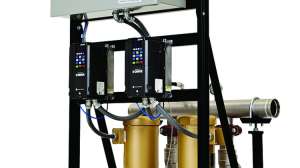
The Series 110 Omni-Valve represents the latest upgrade for Hydro Instruments of Perkasie, Pa., says general manager Andrew Morgan. On the market since January 2006, the control’s linear operation eliminates rotary-drive gears, reducing valve wear by about 80 percent and providing long periods of reliable, continuous operation, Morgan says.
“The biggest problem we had with the traditional way of adjusting the valve stem using rotary drives was you would see the feed rate get itchy — it would go up and down and up and down,” Morgan says. “It wasn’t smooth and it wasn’t terribly repeatable. So we looked to get smooth adjustments and repeatable results.”
With a built-in microprocessor controller, the unit can receive analog communication signals from other instruments, such as a water flow meter or residual analyzer. “The program allows the user to tell the valve what chlorine residual level to maintain,” Morgan says.
The valve also operates in six different control modes, enabling it to handle a wide range of chemicals. Control modes are field selectable and can be changed at any time. Standard options include manual control, proportional (flow) control, set point (residual) control, set point oxidation reduction potential (ORP) control, compound loop proportional-integral-derivative (PID) control and step-feed rate control.
Other features include a 2-by-20 character liquid display, three analog inputs (flow, residual and remote dosage), adjustable dosage, set points, lag time, signal filters, display ranges, alarms and more. The unit also has two 4-20 mA outputs and password-protected settings. For more information: 888/384-9376; www.hydroinstruments.com.