“We learn by doing,” Aristotle observed nearly 2,400 years ago. That’s exactly the experience of biosolids managers in Ocean County, N.J., where the Class A OCEANGRO biosolids-based organic fertilizer is winning customers and awards.
“When we started, we didn’t know much,” explains Dave Ertle, director of central services and fertilizer manufacturing for the Ocean County Utilities Authority (OCUA), based in Bayville. “We had no experience, no markets, no customers, and nobody knew anything about us.”
Today, OCEANGRO is one of the most sought-after fertilizers on the East Coast, and the only thing keeping Ertle and his team from selling more is the amount of wastewater the utility has to work with. The success is due to several factors — operational excellence, product quality and targeted marketing. But for Ertle, it really boils down to unqualified support from top management and the fact that OCUA is in charge of the fertilizer process from one end to the other.
While outside contractors handle biosolids marketing and distribution at other treatment agencies, “We control our own destiny,” Ertle says, “from biosolids production and quality control of the fertilizer product, through to marketing, sales and customer relations. We may be unique in the United States.”
Biosolids to fertilizer
Three wastewater treatment plants (total design flow 80 mgd) serve some 600,000 Ocean County and southern Monmouth County residents in the OCUA coverage area.
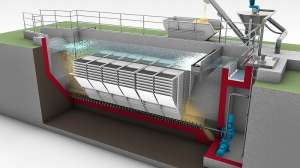
Digested, screened biosolids generated at these plants are gravity thickened, then brought together and blended in a storage facility at the Central Wastewater Treatment Plant in Bayville. Then they are dewatered and thermally dried to make OCEANGRO pellets.
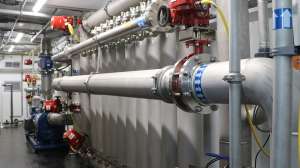
The fertilizer production facility contains polymer preparation and feed systems, three Andritz 2.0-meter SMX-S14 belt filter presses, and two Andritz model DDS-40 drum drying systems supplied by Andritz Separation Inc.
Andritz also operates the fertilizer plant on a 24-hour, five-days-per-week schedule, under the terms of a five-year operating contract that has been renewed twice since plant startup in 1997 (see sidebar).
The pellets are inspected for size and hardness, and then distributed commercially as 5-5-0 (nitrogen-phosphorus-potassium) fertilizer. Ertle reports distribution of about 175 dry tons of OCEANGRO per week (about 8,500 dry tons per year) to golf courses, baggers and blenders, and participant municipalities throughout Ocean County. The OCUA also bags some product and makes it available to homeowners through local garden centers.
The OCEANGRO program received the Wave Award from the New Jersey Association of Environmental Authorities in 2006, and a first place in the U.S. EPA National Clean Water Act Recognition Awards in 2007. Reinforcing the OCUA’s beneficial use program as a national model, the History Channel featured it as part of its “Modern Marvels” series in June 2007.
Lessons learned
While the Ocean County fertilizer project is gaining national kudos, it hasn’t always been that way, and OCUA has learned some hard lessons. The agency’s biosolids management strategy dates back 15 to 20 years, when wastewater treatment plants in New Jersey moved away from ocean dumping and landfilling of sludge.
“We made the decision to turn our biosolids into organic fertilizer and go with land application,” he says. However, despite a lot of hard work, the OCUA’s first attempt at drying was a technological failure. “Even though the technology didn’t work, we remained passionate about the idea of making fertilizer,” Ertle says, “and we had all the necessary infrastructure — trucks and silos, for example.”
After reviewing other processes (Milorganite in Milwaukee, and several plants in Europe), OCUA settled on dewatering and drying technology from Andritz, which agreed to set up a full-scale facility and operate the process through the performance test. The company ultimately agreed to ongoing operation of the plant. “We wanted to make this work, and so did Andritz,” Ertle says, “They met the power and production requirements. They’ve been very responsive to our needs.”
Critical process
Manufacturing a Class A biosolids product that meets environmental and market requirements, day after day and year after year, doesn’t just happen. The OCEANGRO operation calls for constant attention and coordination, and that is where Peter Kusion comes in.
Kusion, operations superintendent of the fertilizer manufacturing division at OCUA, is responsible for making sure the proper amount of solids is flowing from the treatment plants to the drying plant, and that the required quality of biosolids pellets is flowing from the drying operation to the marketplace.
“I account for everything — where it all goes,” he says. “I’m the traffic cop.” That means managing the relationship between the three treatment plants, dryer operator Andritz, the inventory and billing departments, and customers in the field.
“He really stays on top of the issues,” Ertle observes. Using a PC loaded with Active Factory software from Wonderware, Kusion monitors all facets of the operation from his office in Bayville. If the supply of incoming biosolids to the storage tank is too low or too high, Kusion can see that and call for corrections. If the outlet temperature in the drying operation is off specification, or the drying system isn’t getting enough plant effluent for cooling water, he can see that, too, and make necessary modifications.
Staying in compliance and producing a quality pellet are high on his list of critical things to watch. “Our drying operation conforms to a strict air-quality permit,” he says. “And our pellets must meet standards for heavy metals and pathogen reduction in order to be shipped freely as a fertilizer. Regulations play a heavy role in how we operate.”
Kusion also monitors the size and hardness of the pellets, as well as their dust content. “No one wants to handle dust, and dust can cause problems,” he says. The integrity of the pellets helps customers manage the product in the field, and mix and blend it with soil or other soil amendments. Kusion also keeps track of the temperature of the pellets in the storage silos and can mix the material or move it to an empty silo if the material starts to overheat and temperatures spike.
“Monitoring is critical,” he says. Kusion watches the fertilizer plant’s utility usage to make sure operations are efficient. He also maintains the buildings and equipment and orders supplies. He even gets involved in customer relations.
“Sometimes with biosolids products, you can have odor issues if the product gets wet or if the application procedures aren’t properly followed,” Kusion says. “Sometimes I need to go out into the field and work with customers who may have applied the material too heavily or without mixing it into the soil adequately.”
Customer-conscious marketing
The work of Kusion, and Patricia Matarazzo and Scott Rosen who handle customer relations and orders as part of the OCEANGRO project, pays off on the marketing front where customer loyalty is the norm, not the exception.
“Because we didn’t know much when we started,” Ertle explains, “we literally went back to school.” The team spent time with farmers and golf course superintendents, took crash courses in agronomy through Rutgers University, and established a relationship with the former Synagro division of Wheelabrator that helped acquaint the OCUA team with the biosolids fertilizer distribution business.
“We learned by doing,” Ertle says, “We pelletized it, bagged it, stretch-wrapped it, and started providing it to homeowners to demonstrate how safe it was.” The OCUA staff showed people how to use the material. They joined the relevant associations and started a comprehensive communications program, talking to schools and master gardeners, and exhibiting at the annual turf conference in nearby Atlantic City.
They were prepared to handle distribution of the product themselves with their own fleet of two tractor-trailers, a tender truck and five spreaders (made by Willmar Fabrication LLC, and C.U. Stoltzfus Manufacturing Inc.)
OCUA devised forms for sales, shipping, pricing and credit applications, as well as accounting and billing procedures. A Web site gives the public easy access to information about OCEANGRO.
In the first year of distribution, OCUA had an opportunity to demonstrate how biosolids could be substituted for topsoil in the construction of fairways on a new golf course. The success of that project and the experience it gave blossomed into 15 new course construction jobs, as well as jobs at numerous driving ranges and athletic fields. OCUA is now a consultant for engineering firms and golf course architects to help develop turf preparation and development specifications for new projects.
“It took off like wildfire,” Ertle says. “OCEANGRO is organic and slowly releases nutrients that nourish the root structure, improving the health of the turf. It’s doubly attractive now as fuel prices rise and the costs of producing and shipping chemicals and commercial fertilizers increase accordingly.”
In fact, with paying customers that include 40 golf courses, five bagger-blenders who use the material as a fertilizer base, and 15 to 18 garden centers where homeowners can buy 50-pound bags, OCEANGRO is sold out. “I think we could distribute three times what we make,” says Ertle.