Todd Lakey doesn’t need lab tests or fancy instruments to tell whether his treatment plant is running as it should. Sights and smells and a few simple tests generally give him all he needs to know.
Lakey, 44, operates the Village of Trempealeau (Wis.) Wastewater Treatment Facility, a 0.235 mgd (design) plant on the Mississippi River that earned a 2007 National Clean Water Act Recognition Award from the U.S. EPA in the Small Secondary Plant category.
The plant has no in-house laboratory and minimal instrumentation. It does have Lakey’s experience and his keen eye for signs that the process isn’t, in his words, “happy.”
The facility doesn’t just meet its permit requirements — it beats them by a mile. BODs of 2 or 3 mg/l are common, versus a permit limit of 30 mg/l. Fecal coliforms in final effluent are usually in single digits versus a permitted 400 colonies per 100 ml.
Helping the hometown
Those aren’t bad accomplishments for someone who a dozen years ago rarely if ever thought of wastewater treatment. Lakey worked as a barge loader/unloader and heavy equipment operator in nearby Winona, Minn., before Trempealeau hired him to run its new oxidation ditch treatment plant in 1997.
He applied for the job, and the village hired him, before he had any schooling in the profession. The village paid for his education, in which he eventually earned the necessary Grade 2 wastewater operator license.
For Lakey, who has lived in Trempealeau all his life, it was a way to explore a new career and quit commuting. “This is my hometown,” he says. “I love the hunting and fishing in the area. There are a lot of good people. It’s a great place to live — a nice little river town.”
Besides running the plant, Lakey and helper Duane Fruechte assist the village street department with assorted tasks and also maintain the collection system. It was Lakey’s work at the plant that impressed Wisconsin Department of Natural Resources (DNR) officials enough so that they nominated the plant for the EPA award.
“Trempealeau gets large numbers of weekend people in the summer,” notes Judy Hayducsko, a water resource engineer with the DNR. “Having to adjust from smaller to larger flows can be very difficult, and Todd does that very well. Besides performing the necessary scientific tests, he can look at the plant and smell it and use his observations to help determine what to adjust and when. He thinks about what he needs to do, and then he does it.”
Keeping eyes open
Much of the seasonal increased flow comes from a sanitary district serving a large number of cottages along the river. Flow can increase by 20,000 to 30,000 gpd on busy weekends, a substantial change for a plant with an average flow just over 100,000 gpd.
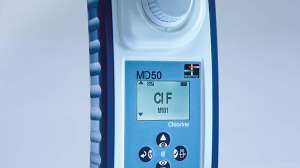
Influent and effluent samples are sent to Davy Laboratories in La Crosse, Wis., for analysis. The plant has its own dissolved oxygen (DO) and pH measurement instruments. Lakey also performs the 1000-ml settling test once or twice per week to help determine when to waste activated sludge from aeration. He also regularly performs the mixed liquor suspended solids (MLSS) test.
“We have an awfully good system here,” he says. “We take frequent DO readings and make sure we provide a lot of oxygen to keep those bugs happy.”
In addition to that, it’s a matter of “keeping a good, watchful eye. I can go to the aeration ditch, take one look, and tell you if it’s happy or not feeling very good. You can tell a lot just from the color of the mixed liquor. If it’s looking thick, if things look like they’re going to slow down and possibly plug up, maybe it’s time to waste the system.”
Besides minding the day-to-day process, Lakey has made some modifications to the plant that improve operations. For example, the storage tank for digested biosolids originally had four decant valves, all at the very top.
“Often, there was a good 10 feet of clears in the tank, and I had no way to get rid of it,” he says. “I had to hire our hauler to empty the tank every year to make sure we had enough room for storage through the winter. I took one of the decant valves from the top of the tank and moved it halfway down. Now I can get two years of storage.”
Fighting foam
Another innovation, mentioned in the DNR’s EPA award nomination, was a cure for a periodic foam buildup in the oxidation ditch caused by filamentous organisms. Foaming can upset normal operations and cause bulking and settling problems.
“We used to hire a vacuum truck to remove the foam,” Lakey says. “But that cost a lot of money.” Instead, Lakey and Fruechte created a portable foam-removal system using a large wet/dry vacuum purchased at a local chain retail store.
They drilled a hole in the bottom of the vacuum and connected a PVC tube to it. They vacuum the foam from the basin and allow it to feed by gravity into a splitter box, from which it is conveyed to the anaerobic digester. There, the foam is treated before decant is sent to the head of the plant and before digested solids are sent to the storage tank. The filamentous organisms can no longer thrive, and problems are minimized.
Another part of sound operation, in Lakey’s view, is simply good housekeeping. “Cleaning is something many people wouldn’t think you’d have to do at a sewage plant,” he says. “But you’ve got to keep things clean. That’s one of the things that I just do. Whether it affects my results or not, I like to keep things clean around here.”
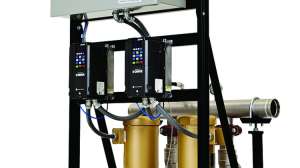
One such task that does affect results is regular cleaning of the plant’s small UV rack disinfection system. “We pull the UV lights once or twice a week and clean them, and we hose them down every day, so there’s no buildup on them,” Lakey says. “That gives us excellent fecal coliform counts. We haven’t even come close to going over our limit on fecals. It’s a really simple thing, but it certainly works.”
And the Trempealeau treatment plant consistently works — to help keep the Mississippi clean for residents and visitors alike.