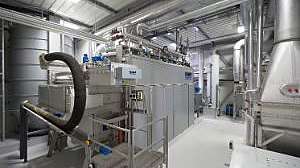
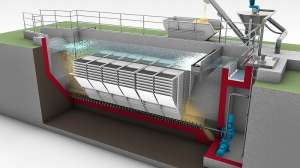
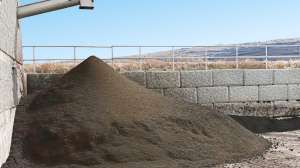
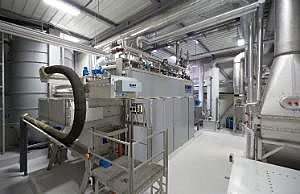
In February of 2015, Midwest City in Oklahoma commenced operations of their biosolids and green waste facility. This was part of Midwest City's efforts to modernize and upgrade their 38 mld water resources recovery facility. The compost facility has one 50 hp BDP agitator servicing four 200 feet long by 6.5 feet wide by 7 feet tall bays. A BDP dolly is used to automatically transfer the agitator from bay to bay. Aeration piping, serviced by 16 blowers, is located at the bottom of each bay, with a layer of stone and wood chips. Compost feedstock is then layered on top of the wood chips. The bays are divided into four zones and utilize temperature sensors that automatically adjust aeration. Due to the building's rural location, it does not currently use an odor system. Once feedstock has spent 21 days actively composting, it is then moved to cure for 30 days in a covered building. Residents are able to drive to the facility storage area to purchase compost directly.
Prior to the composting facility installation, the City was liquid land applying anaerobically digested biosolids on agricultural fields. In addition to the difficulty of storing the biosolids during periods of inclement weather, the City was also paying to dispose of yard waste at the landfill. Instead of persisting with expensive waste management practices and limited landfill capacity, the City chose to blend their biosolids and green waste into a Class A compost product. Midwest City sells out of every batch of compost, with a customer waiting list. As of 2024, the City is selling that compost at $40 (plus tax) per cubic yard.