My first job in community relations was helping a metropolitan clean-water agency win public acceptance for its biosolids (then called sewage sludge) land application program. This was in 1984, around the time the U.S. EPA first made it a policy to promote the beneficial use of biosolids.
At the time, clean-water agencies didn’t necessarily grasp how important it was, in a land application program, to make sure the public understood the practice. So in the neck of the woods where I was working, rural townships, one after another, were passing ordinances to prohibit land application.
To make a long story short, the agency managed to turn things around, mainly by switching from surface spreading to subsoil injection of its liquid product. Since then, slowly (though not steadily, and with exceptions) beneficial reuse has become mainstream. Today we have a host of reuse technologies, many of which involve creating an innocuous Class A product.
Impressive vehicle
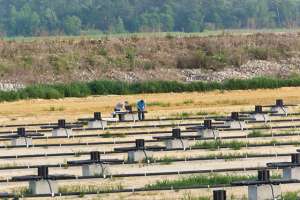
One of these was the subject of an article in the November issue of TPO: The Natchez (Miss.) Wastewater Treatment Facility uses Thermo-System active solar drying technology from Parkson Corp.
I saw that system for the first time (well, not in actual operation) at the 2010 WEFTEC conference in New Orleans. I had someone use my smartphone to take my picture standing next to the computer-controlled “mole” vehicle that travels around the biosolids “greenhouse,” methodically tilling and aerating the material. I sent the picture to my son with a message: “Our next car?” After all, the thing looks quite a bit like a miniaturized Volkswagen Beetle.
Who dreamed back in the 1980s that there would be all these innovative processes? Of course, biosolids were already working miracles back then — restoring strip-mined land in Illinois, boosting silviculture in Washington, and of course supporting incredible crops of corn and feed grain in many places. But in those days, with a few notable exceptions like Milwaukee’s Milorganite, processes like pelletizing and composting were temperamental, and agencies approached them with caution.
Making progress
Today, composting processes have been pretty well perfected, and we have reported on a few of them on these pages. The agencies have little trouble marketing the resulting Class A products, whether to the general public or to commercial users and fertilizer formulators and distributors.
Much the same can be said for dried products. Operators like Synagro make a living on heat drying and pelletizing. And the Schwing Bioset process and others use lime stabilization to produce high-quality products.
Years of innovation have mostly resolved the technical challenge of creating consistent processes that yield consistent products. Odor concerns — the death knell for many reuse initiatives years ago — have been largely conquered. Concerns about long-term environmental issues, like heavy metals, seem to be fading, as well.
And now the biosolids process is going sustainable with solar drying. What could possibly make more sense? In Natchez and elsewhere, we have — a perfectly natural product being handled in a perfectly natural way.
Getting with it
Of course, much of this progress began with a change of attitude about the byproducts of wastewater treatment. The agency I worked for, like many others, began with an attitude that, “We’ve got this awful stuff. We need to get rid of it.” And would farmers please do a solid favor and take it off their hands for free?
That “get rid of it” attitude was perhaps embodied in East Coast cities’ (now outlawed) practice of ocean dumping: Let’s get this stuff as far away and as far out of sight as possible.
The successful agencies back in the 1980s and before were those that realized they had a valuable product that users should be willing to pay for. And that’s the direction in which things have been trending for a long time.
So, given my background, it hurts me a little inside when I see in one of our stories that a clean-water plant is sending biosolids to landfill, or when I hear someone in the industry speak about “disposal” of the material.
Of course I know that sometimes the alternatives are difficult. Land application is still socially unacceptable or cost-prohibitive in some heavily urban areas. And a process like pelletizing or composting may be difficult for an agency to undertake, for financial, technical or other reasons.
Still, I hope that landfilling is becoming the management tool of last resort. It is, after all, a waste. To contrast the old attitude I mentioned, “We have this wonderful product. Let’s make the most of it.”