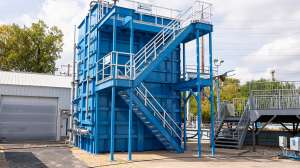
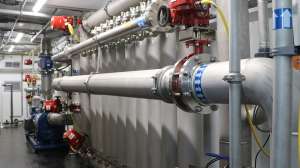
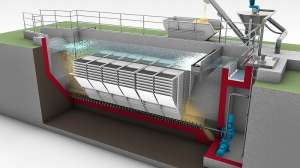
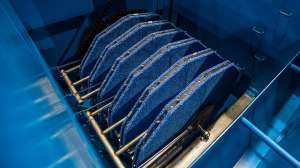
The ClearLogic membrane bioreactor filtration system from WesTech Engineering Inc. uses a submerged hollow-sheet polyvinylidene fluoride (PVDF) membrane with a nominal pore size of 0.2 microns.
The membrane combines the advantages of hollow fiber and flat-sheet technologies. The hollow filter offers high packing density, backflushing and self-healing, and the flat sheet limits fouling while enabling low-pressure operation with fewer chemical cleanings. Together they provide even flux distribution and ultra-low transmembrane pressures (TMP), reducing the accumulation of mixed liquor on the membrane surface.
Lower TMP also means fewer components, less fouling, fewer cleaning cycles, less maintenance and longer life. Typical TMP levels for Title 22 testing range from 3 inches H2O at average flows to 30 inches H2O for peak hourly events.
The system is available in single, double and triple membrane module configurations. The MFM100 offers 1,668 square feet of filtration, the MFM200 3,326 square feet, and the MFM300 4,984 square feet. Made of 316 stainless steel, the modules measure 4 feet by 4 feet and stand 6.55 feet (MFM100) to 13.24 feet (MFM300) tall.
“One advantage of the flat sheet is that it is open on the top and bottom,” says Brad Hansen, MBR group leader. “The mixed liquor and wastewater are free to move around the sheet. That helps it stay cleaner. The hollow fiber is potted on one end or both ends, which means the mixed liquor does not have a clear path to get through, and so it requires more cleaning. Another benefit of flat-sheet technology is that it takes less pressure to pull permeate through. The result is less fouling.”
The ClearLogic system reduces that pressure even more. By combining tiny pores on the filter surface with a polypropylene spacer between the sheets, the amount of force needed to pull permeate through the membrane is reduced to 0.5 psi. The result is less fouling, less cleaning and even flux or greater distribution across the surface, Hansen says.
No pumps are needed to pull permeate through the filter. Ultrasonic welds along the filter sheet prevent separation or ballooning of the membrane when backflushing. That helps promote self-healing in case tiny tears occur. A tongue-and-groove design enables membrane modulesto be stacked so that less air is required during cleaning. Stacking also enables more membrane surface to be packed into a smaller footprint. 801/265-1000; www.westech-inc.com.