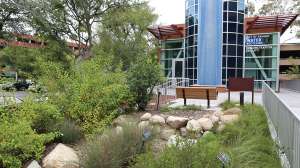
Sometimes numbers can be deceiving, and the Charlton (Mass.) Wastewater Treatment Facility is a case in point. This rotating biological contactor (RBC) plant, rated for 450,000 gpd, was typically treating an average of 220,000 gpd, making it appear that it was running at half capacity and could easily take on additional flow.
But factor in the loadings the facility accepts from the Charlton rest areas on the north and south courses of Interstate Route 90. Loads from those rest areas — the busiest rest areas in the state — have three to five times the strength of residential wastewater, particularly ammonia, nitrogen and BOD. As a result, about 80 percent of the treatment equipment was needed to treat about half the hydraulic capacity of the plant.
At the same time, the Charlton Sewer Commission was having difficulty hiring qualified operations staff for the sewer department. Meanwhile, compliance problems with ammonia, phosphorus and aluminum led to several consent orders.
The commission, left with no choice, enacted a moratorium on sewer connections in June 2004. Then in 2005 the commission elected to proceed with a competitive procurement process to hire a contract operations firm to manage the facility.
Plan in motion
Without the moratorium limiting flow, the plant would have been further compromised and would not meet EPA-mandated discharge parameters. The only exception to the moratorium was that tie-ins were allowed for failed Title 5 inspections.
Needing to address loadings problems, compliance issues and inadequate staffing, the commission members knew they had to act. Early in 2006, the commission hired Woodard & Curran, an engineering, science, and operations firm, to operate the facility.
Woodard & Curran brought in plant operations and maintenance staff to assist the lone plant operator and to troubleshoot and identify system improvements. The plant staff made modifications that improved treatment efficiency, enhanced hydraulic capacity and enabled the moratorium to be lifted.
That process found insufficient alkalinity as a key performance-limiting factor for the nitrification process. The operations team tackled that problem by improving quantity and control of chemical feed, then introducing recycle flow back into the equalization tank, and improving aeration control to create an anoxic treatment zone and reduce the burden on the RBCs.
The staff experimented with different rates of recycled sludge and found 80 to 90 gpm to be optimum. Because of the configuration of the treatment process, they were able to recycle strictly by gravity at no added cost, and monitor the rate with a flowmeter. At this point, they scaled back from six RBCs to four, achieving the goal of using one half of the facility’s equipment for one half of the flow.
The end result is that the original RBC facility now operates in a hybrid activated sludge/RBC mode and uses the equalization basins for both treatment and equalization.
Troubleshooting also found that a local assisted care facility, which contributes 50,000 gpd, was flushing pharmaceuticals and causing failed effluent toxicity tests. At the chief operator’s request, the facility stopped the practice. Since then, the plant has been in full compliance with effluent toxicity testing.
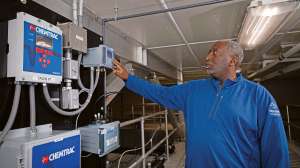
In addition, the team upgraded the chemical feed system to provide a broader range of adjustments and multi-dose point options, improving phosphorus and metals removal. SCADA improvements enabled the staff to track, trend and adjust chemical dosing, improving treatment efficiency for overall nutrient removal.
Phosphorus limits
Charlton’s influent total phosphorus runs from 6.5 mg/l to 15 mg/l, but the plant’s permit limits were 0.2 mg/l during summer. By flow pacing chemicals and monitoring that pacing through the SCADA system, the plant staff was able to fine-tune chemical dosing to obtain optimum results.
Before the flow pacing, staff straight-lined the chemicals, which meant that regardless of flows, the chemical dosing rate was the same. At lower flows, chemicals were being overdosed (wasted), and at higher flows, chemicals were underdosed, and treatment was ineffective. Now the dose rate is tailored to the flow, and the plant consistently attains 0.2 mg/l total phosphorus, and most of the time phosphorus levels average 0.1 mg/l or less.
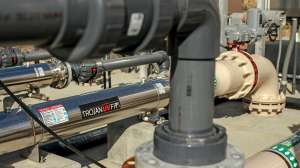
Another problem was that because of the use of ferric chloride, effluent pH was sometimes very low. To maintain pH within permit limits, staff added 50 percent sodium hydroxide and installed a pH monitoring probe before UV disinfection. With that, plus the SCADA system monitoring sodium hydroxide dosing, the plant achieved almost a straight trend line for effluent pH at 7.0.
Ending the moratorium
The hybrid activated sludge/RBC design has improved nitrifi-cation capacity and overall plant stability, and the facility is now in compliance with effluent limits, passing toxicity tests and meeting its 0.2 mg/l phosphorus limit.
The net effect was to increase the plant’s hydraulic capacity by some 100,000 gallons, enabling the commission to lift the moratorium on sewer connections. The lifting of the moratorium is a big step, and the town has begun work to address even stricter permit parameters in the facility’s new NPDES permit.
Construction of an upgrade recently began, and it includes the addition of two RBCs, process improvements to further reduce nutrient levels, and the installation of the CoMag process (a new phosphorus removal technology), to meet stricter phosphorus permit limits.
About the Authors
Jody St. George is chief operator at the Charlton (Mass.) Wastewater Treatment facility and can be reached at jstgeorge @woodardcurran.com. Frank Cavaleri is a senior vice president at Woodard & Curran, a consulting engineering firm with offices in the eastern United States and treatment facilities across the U.S. He can be reached at fcavaleri@woodardcurran.com.