Ohio’s Cuyahoga River has recovered remarkably since 1969, when it drew national attention by catching fire. The City of Twinsburg Wastewater Treatment Plant discharges to Tinkers Creek, a tributary to the Cuyahoga, which in turn flows into Lake Erie. The Ohio EPA classifies the creek as impaired, and the Twinsburg plant and the Tinkers Creek Watershed Partners organization are dedicated to changing that.
The Twinsburg treatment plant is helping with projects designed to minimize non-point source pollution. Those include stream bank restoration projects and, in 2007, the installation of a 900-square-foot rain garden on the plant property. The garden enhances a landscape that the plant staff meticulously maintains, and it’s a main point of interest to visitors and school groups who tour the plant.
Saving the creek
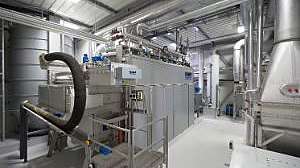
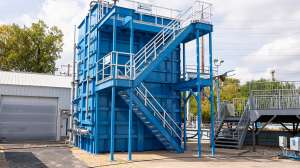
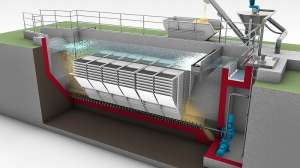
The 4.95 mgd (design) Twinsburg treatment plant serves a community of about 18,000 people located between Akron and Cleveland. It uses a conventional activated sludge process with roughing towers on the front end to help lower BOD generated by a large industrial customer base, and with 16-micron microscreens providing final polishing of secondary effluent.
Nine operators and eight support personnel run the plant and its lab and perform sewer maintenance. Ted Marten, industrial pretreatment coordinator for the Twinsburg plant, led the rain garden project. He also serves on the board of the Tinkers Creek Watershed Partners.
“The Cuyahoga River meets most of the warm-water habitat attainment goals,” he says. “There is a total maximum daily loading (TMDL) limit on the river and also on some of the main tributaries, of which Tinkers Creek is the biggest. Tinkers Creek is in attainment for all criteria except fish populations.”
The Tinkers Creek group’s mission is to increase awareness and build support for the preservation and improvement of water quality, land use, and habitat value in the watershed by offering technical, educational, and NPDES assistance to the communities that use and depend on the well-being of the natural resource. A few years ago, the group asked permission to hold a Watershed Days festival at the Twinsburg treatment plant.
Productive events
“We’ve hosted two of those events,” says Marten. “The first year, we did a stream bank restoration project and the second time, in 2007, we planted the rain garden.”
The plant staff ran piping to capture water from the flat roof of the sludge press and vehicle storage building. The water is piped through the building interior to the outside, where the piping runs underground to the garden.
“The garden is designed to slow the stormwater flow and keep it from flushing into the creek, and also to capture pollutants that the rainwater might pick up from the roof,” says Marten.
The plant staff got instructions from The Rain Garden Manual for Homeowners, a design manual published by the Geauga County Soil and Water Conservation District. The construction and planting was largely a one-day project, completed during the Watershed Days event.
“We used our John Deere backhoe to dig the area out,” says Marten. “We laid the pipe down and brought in special soil designed for rain gardens. It has a blend of sand and organic material. It’s a very porous and water-holding soil.”
The team bought native plants adapted for wet areas from the Ohio Prairie Nursery in Hiram. “We had maybe 40 people here for the event,” says Marten. “We backed a big dump truck over to the site and dumped the soil in, and everybody helped spread it out. We mulched it, and then we brought the plants over.
“Kids and families all did the planting. A gentleman was there who had done some garden design work, and he laid out where the plants should go. It didn’t look like much when we were done, but it’s grown up to be quite beautiful.”
Diverse plantings
The garden started with 13 varieties of plants. “We’ve actually added a few more,” says Marten. “And we get a few that are blown in. When that happens, we have to decide if it’s something we want to keep or if it’s an invasive species. I try to identify them as best I can. The city naturalist, Stanley Stine, comes over and helps decide what should stay and what should go.”
The garden provides a three-season burst of color on the plant property: Irises in spring, sunflowers and red and blue cardinal flowers in summer, asters and native goldenrod in fall, all mixed in with native grasses. Operator Trudy Saxton maintains the garden with help from Marten.
The garden may actually help the plant with its discharge permit limits. The plant may become involved in a water-quality trading program for phosphorus, sponsored by the Ohio EPA. “They’re proposing a program whereby we could get credits for putting in various stormwater mechanisms, such as rain gardens and stream bank restorations, in exchange for phosphorus limitations in wastewater treatment,” Marten says.
“We’re just in the design phases of the trading program. Seven wastewater treatment plants on Tinkers Creek are grouping together to do this work. It may involve going into each other’s communities, or even to communities that don’t have treatment plants, and doing stream bank restoration with city equipment.”
A clean image
Marten notes that an attractive landscape is in keeping with the vision of city public works director Chris Campbell, who insists on thorough housekeeping. “The plant is immaculate,” says Marten. “I’ve been here 18 years, and it was immaculate the day I came. It’s always been that way. We’re right next to a school. We’re in a busy city. We need to keep a good profile.”
The pleasant plant environment isn’t lost on employees. “The rain garden is beautiful to see,” says Jason Alstrom, in his second year as an operator at Twinsburg. “Rabbits, hummingbirds and bees all visit it. The plants are so colorful in the summer that it’s like a sunburst.
“I must say this is the most visually stunning plant I have ever seen. When I first came to work here, I was awed that I was actually in a wastewater plant. It’s a wonder of modern science and natural beauty.
“Tinkers Creek has many meandering bends and plenty of wildlife. I’ve seen beavers, muskrats, raccoons, skunks, carp, cranes fishing in the effluent, and plenty of birds. If the pressures of work become too much, I can just take a stroll on the sampling paths next to the creek to relax. Inside, our buildings are unbelievably clean. Every pipe is painted and dusted. Every handrail is clean. Every light bulb works.”
All in all, it’s a good place to work, and an item on the plus side of the community’s ledger.