They really “go with the flow” in Gainesville, Ga.
For one thing, the community closely monitors conditions in Lake Lanier, the source of its drinking water, which has fallen to historic low levels after a prolonged drought.
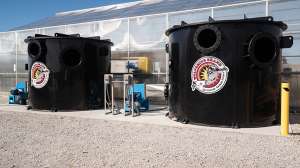
For another, the Flat Creek Wastewater Reclamation Facility operates an innovative in-line flow equalization (EQ) system to cope with high volumes of industrial wastewater from local poultry and food processing plants.
“Our operators have enough experience with the EQ system to know when to cut back or release wastewater into our treatment system,” says Michael West, plant manager. “This maintains a nice even flow throughout the plant.”
The Flat Creek operational team also optimizes power consumption and maximizes contaminant removal at the 12 mgd (design) plant. That’s important, since the plant uses high-end advanced treatment processes and discharges into a tributary that directly feeds Lake Lanier.
Plant processes
At Flat Creek, preliminary treatment steps include bar screens and grit traps, before an influent pump station lifts wastewater to a distribution box feeding two pairs of dissolved air flotation (DAF) units. This is a bit unusual for primary treatment, explains West.
“Years ago, our poultry industries delivered wastewater that was high in fats and oils that wouldn’t settle in conventional basins,” he says. Industrial pretreatment and monitoring has eliminated much of the grease and oil, but the DAF units augment grit and sand removal and help his staff do a better job in controlling solids.
For secondary treatment, Flat Creek relies on activated sludge treatment via a three-stage Carrousel oxidation ditch supplied by Eimco Water Technologies, followed by secondary clarifiers.
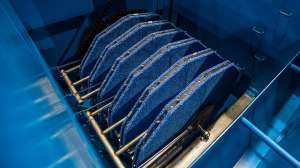
To meet the high effluent quality requirements (3-log removal of coliform, according to the most recent permit), the plant operates deep-bed, continuous-backwash sand filters; tube settlers; and ultraviolet light treatment. The DensaDeg units are from Degremont Technologies; the UV supplier is Aquionics Inc.
A pair of 1.5- by 2.0-meter plate-and-frame filter presses manufactured by US Filter (now Siemens Water Technologies) dewater biosolids. A private contractor, ERTH Products LLC of Peachtree City, Ga., takes the filter cake and has it hauled to Plains, Ga., where it is mixed with pecan and peanut shells and converted into compost.
The Flat Creek treatment train is heavy on innovations, many derived with input from operators when the plant was expanded earlier this decade. West’s team includes assistant manager Randall Hulsey; day shift supervisors Kent Kilby and Ron Carver; night shift supervisors Van Couch and Bomba Satterfield; and operators Tommy Smith, Dewayne Cooper, Billy Duncan, Jimmy Rogers, George Parks and trainee Joey Odell. Trainees Velma Woods and Brett Buffington operate the dewatering equipment. Gene Brown is the maintenance specialist.
“The city made a point of involving treatment plant operators in the design of our facility expansion in 2000,” explains West. “They worked closely with our design consultant [Jordan, Jones and Goulding Inc. of Norcross, Ga.].”
Maintaining a smooth flow
The in-line EQ system is one of the most important of the new ideas. “Our SCADA system allows the operators to control the flow of water to either set of DAF units or both with the click of a mouse,” explains West.
Since the DAF units are the heart of the solids removal system, the SCADA system enables operators to set the amount of waste activated sludge flow to the DAF and/or the recycle clarifier. Each of the waste lines use electrically operated modulating valve actuators that are controlled through PID loops provided through the SCADA software.
The overflow from the DAF trains goes into two EQ tanks, where operators control the valves and regulate flow into the remainder of the treatment system. Three tethered surface aerators (from Ecodyne and Lightnin [an SPX brand]) aerate the contents of the tanks.
“Generally, we save up on flow during the week, and then release flow for treatment on Saturdays and Sundays when the flow into the plant is reduced,” explains West. “The normal routine is that the EQ basin should be empty on Monday morning. The relatively low flow typical of the weekend starts to pick up on Monday mornings as the industries begin production. An operator will close back a little on the flow-control valve that is just downstream of both EQ basin drain valves to start the weekly accumulation process.”
When the level in the EQ basin activates at least one of the floating aerators, the operator opens the flow-control valve to set the flow through the plant. The goal of in-line equalization is to maintain a seven-day mean flow of 5.5 mgd to 6 mgd, except in wet weather conditions.
“Our operators know from years of experience how much should have accumulated in the EQ basins during the course of the week, and they can adjust the plant flow to ensure we stay on track,” West says. “Wastewater plants tend to run smoothly when a consistent linear flow is applied all of the time, and the EQ basin allows us to provide that. In addition, in-line equalization provides an excellent buffer against shock loads or toxic influent streams by allowing for a substantial dilution factor before the condition is allowed to pass to the biological train.”
Smart power
The Flat Creek EQ system also enables smart power use through a real-time pricing agreement with the plant’s electrical power provider, Georgia Power, a Southern Company, Atlanta. “The power company has established a baseline power supply that we need to operate at a minimum level,” West says. “When local power demand increases, the per kilowatt-hour rates start to rise. We can access the Georgia Power company Web site and see a chart that will project power demand one full day in advance.
“If we know that the price of power will go up between 3 p.m. and 9 p.m. the next day, we will make provisions to cut back the flow during those hours and allow the excess water to accumulate in the EQ basin.”
For example, staff can shut down a 200-hp aerator due to reduced oxygen demand, or turn off several other high-volume electrical loads for short periods based on flow reduction through the plant. The Web site also provides the actual kilowatt usage by the hour and snapshots of historical data for almost any timeframe the plant wants to see. The end result is a power reduction of more than 20 percent, according to West.
Preventing overflows
Flat Creek also has a proactive program of preventing sewer overflows. According to West, the utility simply practices thorough and careful monitoring of the sewer system and the 54 lift stations on the lines.
“We have several teams involved in inspecting and monitoring the system,” West says. “We hardly ever experience an overflow.”
One team monitors lift stations on a regular basis to detect potential problems before they occur. The city’s collections and distribution crews constantly check sewer lines for blockages and other issues. They maintain a database, monitoring flows with portable flow meters. In addition, utility “creek walkers” are out in the field every day inspecting pipes and outfalls.
In this way, the plant and collection system work together to protect water resources in a drought-sensitive community.