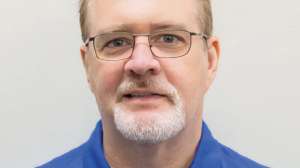
For Andrew Knight, every day at work is different. What never changes is his enthusiasm for his job as an operator II at the 200-mgd (design) Columbia Boulevard Wastewater Treatment Plant in Portland, Ore.
Knight, an eight-year employee of the plant, works as a lead operator in the biosolids area, which processes some 40 dry tons per day. His passion for doing a quality job grows in part from his love for the plant’s receiving stream, the Columbia River, where he fishes for salmon and sturgeon.
Knight’s dedication has earned him not only the respect of his peers and managers but also recognition from the Pacific Northwest Clean Water Association (PNCWA), which named him Oregon Operator of the Year for 2008.
“You need to have personal drive,” says Knight. “You need to have some personal motivation. For me it’s the environment. It’s definitely a priority of mine to keep the river clean. I want my daughters to be able to fish it, and I want to continue to have a good, healthy river for myself.
“I want to go home at the end of the day and feel good about myself. I want to feel at the end of the day that I earned my paycheck, and that I did the best job I could.”
‘Can-do, can-change’
His supervisor, Tuong Nguyen, observes that Knight is full of ideas and likes challenges. “Andrew has a great approach to his work,” Nguyen says. “He has a can-do attitude, a can-change attitude, that is really refreshing. Everybody has ideas, but when you want somebody to take an idea and do something with it and make it work, that would be Andrew.”
Knight is responsible for optimizing performance in the biosolids area at Columbia Boulevard. His primary job is to operate gravity belts and the polymer control system, but he has also been involved in operating belt presses, lagoon dredging equipment and batch systems, and in laboratory analysis.
In its award summary, the PNCWA cited his service on a plant safety committee and his handling of several job hazard assessments. His group at Columbia Boulevard achieved certification under Oregon OSHA’s Safety & Health Achievement Recognition Program (SHARP).
“Andrew is frequently asked to participate on teams and committees where his operational viewpoint is valuable,” the award summary said. “He has exceptional communication skills, takes pride in his work, and sincerely cares about the effectiveness of his efforts.”
Pursuing an interest
Knight’s interest in the outdoors and the environment led him to enroll in the Natural Resources program at Oregon State University after high school. After three years there, he saw a weak job market and fierce competition for the few jobs available.
“I had a friend who was in the wastewater business, and he told me a little about it,” Knight says. “I transferred to Linn Benton Community College [in nearby Albany] and entered the Water and Waste-water Technician program there.” He received a two-year associate’s degree in 2000.
After graduation, he won a summer internship at Columbia Boulevard, where he did mostly general housekeeping and got an introduction to the plant and the industry. At the end of the internship, he accepted a trainee position. Two years later, he moved up to an operator II slot in the biosolids area.
After six months there, he joined the Special Operation Group (SOG) as a member of a quick-response team handling maintenance tasks, emergencies and special projects. A few years later, he transferred back to the biosolids area to get a work schedule more conducive to spending time with family. He and wife Kristin have two daughters: Adrienne, 3, and Lindsey, 6 months.
Along the way, Knight has earned continuing education units (CEUs) in short-school classes at Clackamas Community College in Oregon City, in a program sponsored by the Water Environment Federation.
Part of a team
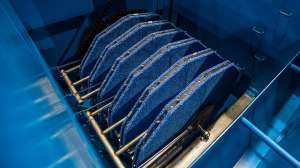
Knight’s team consists of half a dozen operators on rotating shifts. On a given day, two operate the dredge that draws biosolids from a 37-acre lagoon to be fed to two holding anaerobic digesters, and one operates the four belt presses (Ashbrook Simon-Hartley). Knight or a colleague functions as lead operator, running the three gravity belts (also Ashbrook Simon-Hartley) and controlling the polymer system.
The lead operator is also the first point of contact for any plant employee who interacts with the biosolids group. “We deal with maintenance people and electricians and facilitate when they can come in and shut down equipment for maintenance or repairs,” Knight says.
Because the equipment is old, workdays can be somewhat unpredictable, but the biosolids area is still a more stable workplace than the wet side, where flows can range from 15 mgd at night to 300 mgd during a daytime rainstorm.
Enhancing the process
In the biosolids treatment process, waste activated sludge (WAS) is thickened up to 5 percent solids using gravity belts and polymer before being sent to two of eight digesters (1.3 million to 2.4 million gallons/each, capacity).
After 20 days, about 80 percent of this digested, thickened WAS is sent to the lagoon for further aging and conditioning. The remaining 20 percent is mixed with digested primary sludge and dredged sludge from the lagoon before being sent to the belt presses. “This ‘soup du jour’ blend is where the skills of Andrew’s team show through, as they produce the best possible biosolids cake, consistently north of 20 percent dry solids,” Nguyen says.
After digestion, finished biosolids are dewatered on the belt presses to a cake containing about 20 percent solids. A contractor then hauls the material to the land application site, a privately owned farm and ranch operation outside Portland.
When a large digester was recently taken down for several months for installation of a new mixing system, a solids-handling problem arose that Knight helped to remedy. “Because one of our two main digesters was down, we were working with one digester,” Knight says. “We were pulling solids out of that digester while also pumping dredge material into it.
“The way our piping was set up at the time, the line we were pulling out of to feed the belt presses was the same one our lagoon dredge line pumped into. So we were mixing the flow and sending direct lagoon flow over the belt presses. You need a fairly uniform flow over belt presses in order to run proper polymer ratios. If your feed is highly variable, you can’t set the belt presses right to get good-quality cake.”
Knight and colleagues found a way to split the flows, isolating the pump flow to the presses from the flow entering the digester from the dredge. “It sounds simple, but it really wasn’t,” Knight says. “It saved us a lot of headaches.”
Looking ahead
Challenges like that help keep Knight enthusiastic. He’s especially interested in the technology coming into the field. “Things are changing constantly,” he notes. “Operators need strong computer skills today. Maybe 15 years ago, everything was push-button manual start. Now everything ison a SCADA system. Without computer skills, you’re going to be in a world of hurt.
“I spend a lot of my time looking at trend charts. That alone gives us a wealth of knowledge,” Knight says. “Before, when something unusual happened, you reacted from experience, or from memory. Now, I can look through a dozen trend charts and see that at 2:38 p.m., this spike occurred. Why did it happen? I can look at other trend charts and see what might have triggered it. Did a pump go out? Did a pump turn on? Did our pH go up? It’s a lot easier to troubleshoot now with the advent of computers.”
As one who thrives on change, Knight sees a bright future at Columbia Boulevard and in the profession. While his main focus now is on his family, he hopes in time to further his education. He planned to take his state certification exam in March.
“I studied three years at Oregon State, but didn’t finish my bachelor’s degree,” he says. “I’d like to go back and do that, especially to set a good example for my daughters. Eventually I’d like to get into the management team here. I think we have a real strong team, and it would be nice to be a part of that.
“I think I have a solid career here in an industry with a very strong outlook,” Knight says. “I earn good pay and decent benefits. I have job security and a place I can come to and feel as if I’m doing something for the environment. There aren’t many young people in the wastewater field. There’s a whole lot of opportunity for those of us who are here.”