At the Dublin San Ramon Services District, green operation has become a top priority — and second nature. The district, headquartered 30 miles east of San Francisco, Calif., has undertaken a long list of green initiatives, and more are on the drawing board.
The district goes well beyond the basics of generating its own power using digester gas and saving energy with cogeneration. It has invested in power generation with fuel cell technology and photovoltaic cells. “If green projects are economically viable and they show some promise, our board likes to tackle projects that will show the district as a leader in the industry,” says Dan Gallagher, operations manager for the district, including its regional wastewater treatment facility. “We consider ourselves environmentalists.”
Fueling up
The district lies in California’s San Ramon Valley, sandwiched between the San Francisco Bay area and the agriculturally rich Central Valley. Green operations are nothing new for the DSRSD, but with advances in technology and forward thinking, they’ve taken some twists.
The newest program is a pair of 300-kW fuel cells the district acquired a year and a half ago, thanks to a $2.7 million grant from the local utility, Pacific Gas & Electric. The fuel cells are installed at the district’s treatment plant, located in Pleasanton, Calif.
“Fuel cells are like a battery,” says Gallagher. The difference is that conventional batteries generate power from chemical reactions involving materials inside them. Fuel cells continuously take in fuel from an outside source and turn it into electricity. The DSRSD’s fuel cells are DFC300 models from FuelCell Energy Inc., based in Danbury, Conn. They’re powered by methane from the plant digesters.
The fuel cells consist of an anode and a cathode, both made of nickel, with an electrolyte sandwiched between them. FCE’s cells use molten carbonate for the electrolyte.
The hydrogen-rich methane and water are applied to the anode, where they react to separate the hydrogen from the methane. The hydrogen then reacts with carbonate electrolyte ions, producing water and electrons. The electrons from the anode side of the cell cannot pass directly through to the positively charged cathode. Instead, they traverse an electrical circuit to reach the other side of the cell, creating a DC current.
While the fuel cell does give off some carbon dioxide (along with water), its carbon footprint is much lower than that of an internal combustion engine.
Sun Power
Along with the fuel cells, the district is exploring solar energy. A new maintenance building, under construction, will be equipped with photovoltaic panels to collect sunlight and convert it to electricity.
The solar project is a small-scale test. Gallagher doesn’t expect it to produce a great deal of electricity, but if it works, bigger projects could be in the offing. “We’re going to use those solar panels to put power back onto the utility grid,” he says. “We’re exploring cooperative ventures with other agencies around the area.” One possibility is a photovoltaic “farm” that would place an array of solar panels out over a stretch of land.
The solar and fuel cell projects build on earlier projects to generate electricity in-house for the district.
These innovations fit perfectly with more traditional ventures in green operation. The district installed a cogeneration system 20 years ago, and today, the plant boasts three 500-kW Waukesha Engine generator sets fueled by natural gas and digester methane. Heat drawn from engine coolant is used for heat and air conditioning.
The district still is hooked up to the local electric utility, “but we’re generating most of our own power here within our own fence line,” says Gallagher.
Indeed, the amount of electricity generated in-house is enough so that the district could sell some back to the utility, but Gallagher says that so far there is no financial incentive to do so.
That power costs about 8 to 10 cents per kWh to generate, versus 22 to 23 cents per kWh to purchase from PG&E, Gallagher says. But under state regulations, the district can only sell back excess power at 8 to 9 cents per kWh — meaning the district would lose money on the sale.
The solar project could change that: Unlike other self-generated power, solar power can be sold back to utilities at the full time-of-use market price — a strong incentive to undertake that project.
Giving back the water
The solar and fuel-cell projects and the cogeneration initiative join other green projects at the district. Gallagher says the district’s use of recycled wastewater grew out of a project that dead-ended because of public opposition.
“Back in the late 1990s, the agency was trying to construct and operate a project that would have treated wastewater and then injected it back into the ground for groundwater recharge,” Gallagher says. But just before it was to be implemented, public concern led to its cancellation.
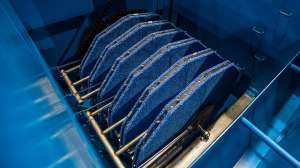
However, the district had already built the tertiary treatment system for the project, consisting of reverse osmosis (RO), micro-filtration (MF) and ultraviolet (UV) disinfection. Instead of offering treated water as a groundwater recharge, the district mothballed the RO equipment and used the MF and UV portions to produce recycled water for irrigation.
A few years ago, the district teamed with the East Bay Municipal Utility District to expand recycled water distribution and increased the output from 3 mgd to 9 mgd. “We still had to do some public education and outreach to explain that this wasn’t going to harm the environment, that people didn’t have to worry about their kids playing on the school field after it had been irrigated with recycled water,” Gallagher says.
Demand is growing, though. “A lot of developers that move into the area say, ‘We will not develop this unless you can provide recycled water to us,’” he says. “Not only are the economics more favorable to use recycled water for irrigation, but a lot of developers want to do those kinds of things because of the way the public perceives the importance of being green.”
Back to the land
Another traditional program involves land application of the district’s biosolids to a 55-acre former military site next door to the treatment plant. The site includes a wildflower meadow that also serves as a nesting ground for migrating Canada geese.
“We adjust our operations so we don’t disturb them while they’re raising their young,” Gallagher says. “It’s a very environmentally friendly process — one that means we don’t export our biosolids out of state. We take care of the material we produce right here, with a facility that’s fully permitted and very environmentally friendly.”
While the in-house land application program is “very cost-effective,” the district is exploring other options, including offering the biosolids to Central Valley farmers as a soil amendment or pelletizing the material for fuel.
To Gallagher, it all fits in perfectly with the district’s mission. “Wastewater treatment plants around the country take waste that we as human beings produce on a continuous basis and clean it up to the point where it can go back in our rivers and streams and the ocean without causing gross pollution,” he says.
In short, going green isn’t just about saving money or doing the right thing: It’s a natural extension of the district’s basic reason for being.