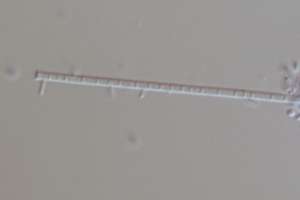
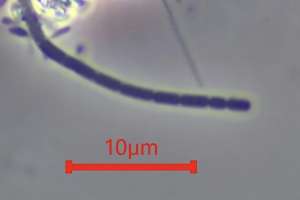
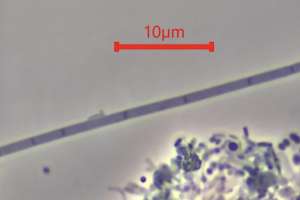
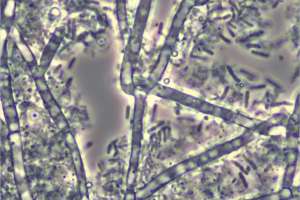
Filament type 0803 has a unique backstory, and depending upon the reference source, has various potential associated growth causes.
The manuals written by...
As phosphorus limits are becoming increasingly stringent in biological wastewater treatment processes, the number of treatment plants that are striving to achieve...
Because bacteria are responsible for the vast majority of treatment, the general success or failure of systems depends on maintaining adequate populations...
Type 1701 filaments have highly similar morphology to Sphaerotilus filaments, and these two morphotypes could arguably be combined if the diameter value...
Type 0961 filaments are readily distinguishable at 1,000x oil immersion phase contrast as a light or transparent filament with rectangular cell shape,...
Historically referred to as Nocardia, Gram-positive branched filaments generally ranging from 0.8-1.2 µm in diameter with visible septa (cell walls) are a...
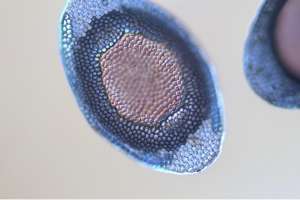
Sponges are nonmoving invertebrates that have specialized cells for filtering water for food. Freshwater sponges filter out food such as bioplankton and...
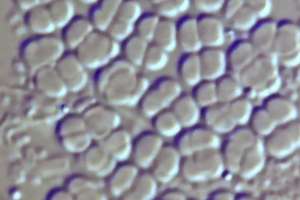
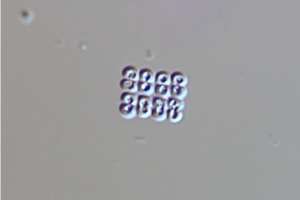
The microorganism morphotype description for this month’s feature has been recognized as the Thiopedia morphotype by Dr. Michael Richard and Dr. David...
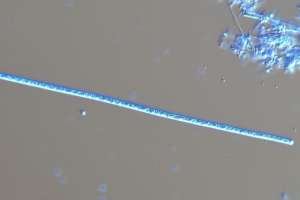
Eickelboom morphotype Beggiatoa is readily recognizable due to its large diameter (2-4 µm) and its slow-gliding motility. Sometimes septa (cross-walls) may be...
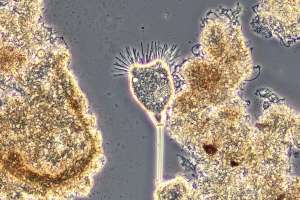
A suctorian is a protozoa from the order Suctoria, which includes both saltwater and freshwater organisms. Suctoria are widely distributed in nature and...
Fungi at low levels are common or insignificant and often incidental visitors to wastewater treatment processes, although at higher abundance fungi may indicate...