When structural deterioration forced the shutdown of the dewatering building at the Barberton Wastewater Treatment Plant in Ohio, the question wasn’t just how to fix the building — it was how to keep processing sludge while doing it. With a major rebuild on the horizon and daily sludge still coming in, the solution came in the form of a container on wheels: the Esmil Module D mobile dewatering system.
Building breakdown meets operational urgency
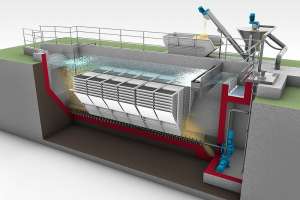
The Barberton WWTP treats an average of 6 mgd, with a peak design capacity of 12 mgd. For years, the plant operated two belt filter presses in its dewatering building, before upgrading to a four-drum Esmil MDQ-404CL multi-disk screw press. The system routinely processes 90 gpm of sludge at 3% DS, generating dry solids of up to 1,350 pounds DS/hour, with final cake concentrations ranging from 23–25% DS — all while running up to seven days per week.
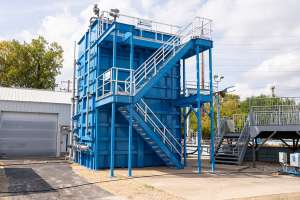
However, after years of service and exposure to harsh conditions, significant corrosion had taken its toll on the walls and structure of the dewatering building. The only viable option: a full demolition and rebuild. But shutting down the building meant shutting down the Esmil multi-disk screw press. With construction expected to last six to eight months, the plant urgently needed a temporary yet robust dewatering solution.
The Challenge: Dewatering without a building
With sludge continuing to arrive daily from primary clarifiers, the Barberton WWTP faced a critical challenge: how to maintain uninterrupted dewatering operations without access to its in-building equipment. Any downtime would mean costly hauling of liquid sludge — or worse, process bottlenecks.
The Esmil response: A containerized solution around the corner
Fortunately, help was just down the road. Esmil’s U.S. production and support facility is located less than 20 miles from Barberton — and even more fortuitously, a brand-new Module D mobile dewatering unit was nearing readiness for field deployment.
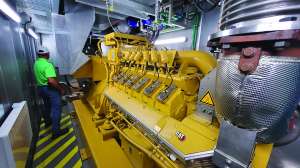
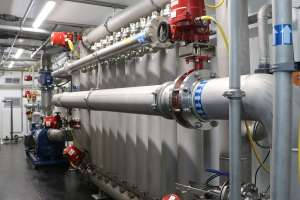
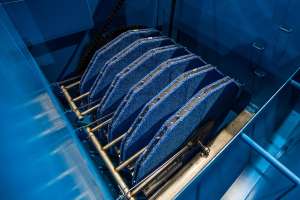
The Esmil Module D is a complete, self-contained dewatering system housed within a custom-modified 40-foot shipping container. Designed for minimal site requirements, it needs only water, power, and sludge to operate. Inside, the system is equipped with:
- An Esmil MDQ-403CL three-drum multi-disk screw press
- Neat polymer feed system, with onboard storage for a tote
- Macerator, sludge pump, and flowmeter
- Shaftless screw conveyor for cake discharge to a dumpster or truck
- Full operator workstation, HVAC system, and safety lighting
The system is engineered to match or exceed the throughput and performance of the plant’s in-house press, while requiring minimal operator involvement. Startup is fast, and performance is consistent — just what the situation demanded.

Results: Performance, flexibility, and peace of mind
Thanks to Esmil’s quick action and geographic proximity, the Barberton WWTP avoided operational disruption during an otherwise difficult construction project. The Module D system was brought online quickly, with no compromise to dewatering throughput or cake quality.
Beyond just bridging the gap, the mobile unit provided additional value:
- Consistent high cake solids (in the 23–25% DS range)
- Low polymer consumption
- Minimal labor demand — ideal for extended use
- Scalable design for rental, pilot testing, or emergency response

A win-win for plant and vendor
The Barberton case underscores how a well-engineered mobile system can solve urgent infrastructure challenges without sacrificing performance. The Esmil Module D not only kept the plant’s operations on track, but also showcased the flexibility and reliability of Esmil’s dewatering technology — in any form, permanent or portable.
For treatment facilities facing uncertain timelines, aging infrastructure, or high-capacity temporary needs, containerized dewatering may just be the future — and the lifeline — of solids handling.
To learn more about Esmil dewatering systems, visit www.esmil.us or contact 646- 286-5512.