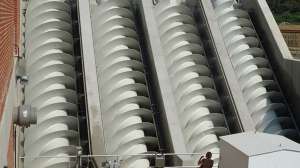
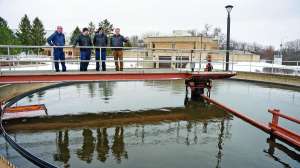
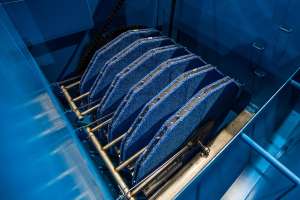
SD1 Western Regional Wastewater Treatment Plant is located on the Ohio River in heavily industrialized northern Kentucky. The plant’s primary function is to disinfect municipal and industrial wastewater before introducing the water back into the Ohio River.
The plant had been using a UV system to disinfect its effluent, and although it was in good working order, issues arose due to the industrial loading.
The plant gets heavy industrial flow containing a significant number of contaminants and the UV system was unable to reliably meet mandated disinfection requirements.
The Solution
Dave Koetting, plant manager, contacted Pelton Environmental Products about peracetic acid and Blue-White Metering Pumps. Pelton partnered with Ohio Valley Service Solutions, in Cambridge, Ohio, to provide complete system installation services.
Ohio Valley Service Solutions provides turnkey installation for process, chemical feed and rotating equipment to municipal and industrial customers throughout Ohio, Kentucky and Indiana.
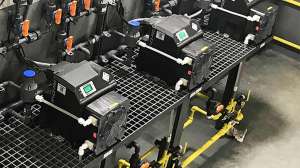
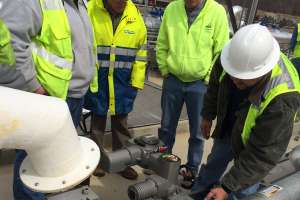
Because the UV system could not adequately meet disinfection needs, the Ohio Valley technician opted to switch to a chemical treatment solution and installed a duplex skid system equipped with two Blue-White FLEXFLO M3 peristaltic metering pumps.
The chemical chosen to deliver reliable wastewater disinfection is peracetic acid at 15% solution under minimal pressure.
PAA is an organic chemical made by combining acetic acid with hydrogen peroxide using a catalyst. It has a vinegar-like odor and is typically sold in a solution of acetic acid, peroxide and water. PAA was first used as a disinfectant in the early 1900s and was registered as a disinfectant with the U.S. EPA in 1985.
Some benefits of PAA include that it’s environmentally friendly, and when it oxidizes, it breaks down into acetic acid, water and oxygen. This makes it safer to use on effluent discharged into source water or other bodies with high levels of organic content. PAA oxidizes almost instantly, so there is rarely any residual chemical after discharge.
For now, few regulations affect the use of PAA, as it breaks down quickly and does not form any known disinfection byproducts.
PAA has an estimated shelf life of six months to two years. One issue with PAA is that it is an off-gassing chemical, which is why a peristaltic pump makes an excellent choice, as there are no valves to clog. The FLEXFLO M3 experiences no vapor lock and no loss of prime when dosing PAA.
Another benefit of the M3 is the pump’s broad turndown range and 4-20mA adjustment. These are important considerations because the plant will eventually change overall systems from UV disinfection to chemical disinfection, and operators have chosen to standardize on one chemical feed solution, the FLEXFLO M3 peristaltic metering pump. The pump’s 10,000:1 turndown range means it will easily and successfully meet a broad spectrum of feed rate requirements.
Maintenance and spare parts inventory are also a consideration. The M3 requires very little regular maintenance, just periodic pump tube changes. The simplicity of changing the M3’s pump tube factored into Ohio Valley’s decision to choose this particular peristaltic pump. Spare tube assemblies are the only parts inventory needed.
Blue-White has prided itself on cutting-edge technology, quality materials and excellent customer service since 1957. The company’s approach is to simplify the chemical metering and fluid measuring process to give users peace of mind and to invent new technologies. The company has a worldwide network of factory-authorized representatives, distributors, dealers and warranty centers.
714-893-8529 | info@blue-white.com | www.blue-white.com