Cost-effective handling of biosolids is essential to clean-water plants’ economic and environmental performance.
The Immokalee Water and Sewer District in Florida faced a biosolids challenge in 2006. The district had been using drying beds to create Class B biosolids and spending about $500,000 a year to dewater and haul excess material from that process to a landfill.
Facing a change in regulations on land application of Class B material, and wanting to reach the biosolids’ full economic potential, the district looked at alternatives. The ultimate solution was a facility redesign centered on using the Bioset process (Schwing Bioset) to create Class A biosolids. As a result, the district has reduced handling costs by more than two-thirds and produces a Class A product for beneficial use.
Located about 30 miles southeast of Fort Myers, the heavily agricultural Immokalee district is home to about 24,000 residents. Its wastewater treatment plant was expanded in 2013 from 2.5 mgd to 4.0 mgd design capacity. Until fairly recently, it generated 23,500 gallons of Class B biosolids per day at 1 to 1.5 percent solids.
Gary Ferrante, P.E., an engineer with the Greeley and Hansen engineering firm, says a number of factors in 2006 led the district to review its biosolids operation. “Immokalee’s plant was originally designed with a half-dozen drying beds in which a Class B biosolids was created and used on permitted area farms,” he says.
“While that was effective, the facility is next to a school, which repeatedly complained about students’ health risks and odor. The district later learned that the U.S. Department of Agriculture and the Florida Department of Environmental Protection were considering changes to biosolids land application regulations (passed in 2010 as Florida Biosolids Regulation Chapter 62-640 F.A.C.). All that prompted the district to hire a consultant to look at alternatives.”
Based on recommendations from the consultant’s report, in 2007 the district contracted with Synagro Technologies to dewater the Class B biosolids and haul it to a landfill more than 100 miles away. In time, rising prices and an increase in biosolids volume raised annual costs from $309,000 to more than $470,000, providing incentive for the district to pursue other options.
“Working with the district, we put together a couple of proposals and a couple of scenarios within each proposal,” says Ferrante. “The first one covered the design/build/finance of a biosolids facility at the existing location. Options under this plan included handling material from Immokalee only, as well as accepting material from Collier County and making Immokalee a regional processing facility. The second proposal had an outside entity leasing land from the district and constructing a Class A regional processing facility on it.”
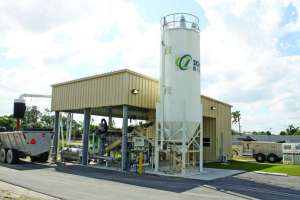
An option under that proposal included a continuation of the contract dewatering program while the regional facility was taking shape. In the end, the district chose to establish a turnkey processing facility for its own biosolids sludge only and selected the Bioset process to deliver Class A material.
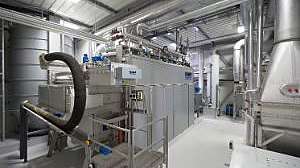
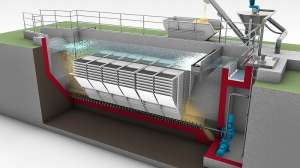
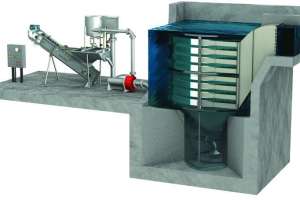
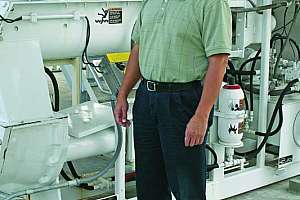
At the new facility, material exits the primary treatment facility’s sludge holding tanks at 1.5 percent solids and is fed directly to a high-performance screw press, selected for a number of reasons, including its relatively compact design.
“Because of the limited availability of usable land, a small footprint for the entire biosolids system was a major consideration, and the Bioset screw press fit in nicely,” Ferrante says. “We’ve found it to be an outstanding dewatering tool, yet extremely efficient in power usage.
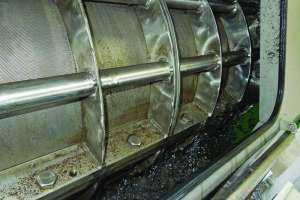
“The belt press we looked at would have taken the material from 1.5 or 2 percent solids up to 8 to 10 percent. A centrifuge might get that up to 20 percent, but the electricity costs would be much higher. The screw press takes the material up to 16 percent solids. It uses twin augers and a changing pitch on the screws to advance the material and remove the water. Because it takes far less energy to turn those two screws than to power a centrifuge, the savings in power consumption can be significant.”
Another feature is that district personnel can wash the screw press down while it remains operational, says Michael Castilla, service technician 1: “The Bioset screw press has an automated self-cleaning function which in itself is nice. However, when we have a situation that calls for additional cleaning, we can simply push a button and a cleaning cycle will start. That’s a bonus. To shut a press down for maintenance or repair could cost us a half-day’s performance.”
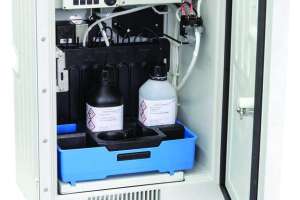
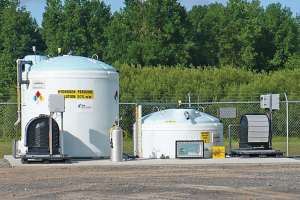
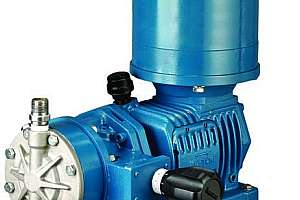
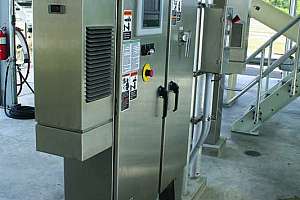
After dewatering, untreated biosolids are taken via screw conveyor to a twin-screw mixer in which quicklime and sulfamic acid are added. The mixing resolves issues such as unreacted lime in the final product and yields a highly homogeneous material. From the mixer, a Schwing Bioset KSP-10HKR pump feeds material into a 56 1/2-cubic-foot reactor in which heat from the acid and quicklime reaction raises the pH, stabilizing the mixture and creating a product that meets both Florida Chapter 503.33 and U.S. EPA Class A requirements.
“Retention time in the reactor is about 30 to 45 minutes at temperatures in the range of 122 degrees Fahrenheit,” says Ferrante. “The plant wastes sludge for 16 hours a day, consistently generating about 11 dry tons of the Class A material weekly and doing so at a markedly lower cost than for outright hauling and landfilling.”
Castilla adds that the system’s ease of operation was also key to getting up to speed quickly.
“It is very intuitive and simple to operate,” he says. “However, Schwing Bioset still went to great lengths to ensure that people involved in day-to-day operation are comfortable with it, have a handle on the maintenance routines, and so on. Ian Keyes from their Wisconsin office spent time here mentoring me to such a degree that there’s very little about the system I don’t understand.”
The Class A material exits the system, is loaded onto a manure spreader and taken to an area field where it is applied in place of fertilizer. Eliminating those fertilizer costs alone has saved about $50,000 per year.
In addition to lower costs, the district benefits from a much cleaner, less maintenance-intensive, more environmentally friendly operation. Dust from the lime-based process is controlled using hard-piped or totally enclosed components. Odorous air is contained by the pressurized reactor and then captured and scrubbed under a collection hood before release.
The district’s biosolids plant was designed with ample space to install a second identical processing line in case the regional concept becomes a reality. “One of the most important aspects of this system is its ability to accommodate the changes a regional operation would entail,” says Ferrante. “Things like fluctuations in the percentage of solids, increases and decreases in throughput, and compatibility with biosolids from aerobic or anaerobic digestion processes without modification, are all within its design capability.
“Simply put, the district is well positioned to have its wastewater treatment needs met for the foreseeable future. After the $2 million design/build/finance contract was awarded, the district, seeing itself in a good financial position, opted to pay that cost out of pocket, rather than financing it over 20 years.”
The annual operating cost for the new system is about $130,000 a year, including chemicals and electricity. With estimated savings of $370,000 per year over landfilling, the system will pay for itself by about mid-2019.
“This was a case in which Immokalee, a small independent special district with a serious financial headache, took real initiative in getting things done,” says Ferrante. “They will be the beneficiaries of those sound decisions for decades to come.”