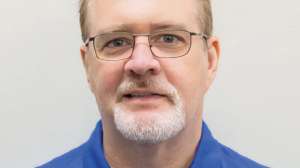
Tom Sinclair loves his job and always has: “I think about work constantly — how I can make it more efficient and help others make their job easier.” That philosophy drives him, and it has reaped rewards for himself and his employers.
Trained as a dental laboratory technician, Sinclair moved into the municipal wastewater field when his dental position was eliminated. Working up from maintenance to operations to industrial pretreatment, he enjoyed the wastewater field. Then, he found his calling: household hazardous waste collection.
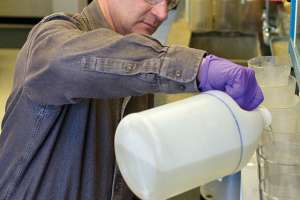
Since 1996, Sinclair has worked as an industrial waste engineer and household hazardous waste (HHW) coordinator for Monroe County, N.Y. He oversees hazardous waste identification, disposal and transportation of 250 to 300 tons of HHW per year.
His experience in wastewater has helped him in his new career: He understands the impact industrial waste has on treatment plants, waterways, landfills and the ecosystem. His background has also been valuable in his dealings with all levels of wastewater treatment staff, industry, and residents.
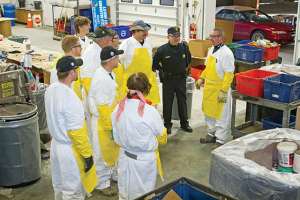
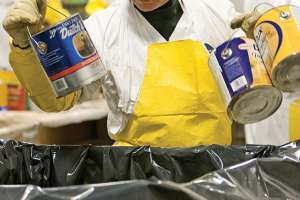
Having worked in the field, he’s not afraid to get into the trenches. “I can be out in a suit and tie giving a presentation at a conference or business organization, and an hour later I am wrapped up in Tyvek handling hazardous waste,” he says.
As HHW coordinator, Sinclair also oversees the dental pollution prevention program, started the first pharmaceutical waste collection program in the State of New York, and helped launch a one-stop recycling center for a vast variety of materials.
The pharmaceutical program’s success won him the 2010 Charles Walter Nichols Award from the American Public Works Association (APWA) for outstanding achievement in the environmental field.
Sinclair is an example of what is possible for clean-water professionals who want to explore sides of an environmental service career outside the treatment plant. His experience illustrates just one of various other pathways professionals can follow after mastering the plant operations and management roles.
Sinclair began his municipal career in 1980 at the Town of Tonawanda (N.Y.) Wastewater Treatment Plant as a maintenance person. In 1985 he became treatment plant assistant, operating equipment, collecting and analyzing lab samples, and performing maintenance. He became a certified treatment plant operator in 1990, a role in which he supervised facility operations including lab work, employee training, and resolution of consumer complaints.
Along the way, he took advantage of the plant’s in-house training program. He also took the Great Lakes Grade II wastewater operator course from State University College of New York (SUNY) at Buffalo, and the wastewater treatment operator correspondence course from California State University.
The plant’s small size allowed him to do everything from working in the lab, to biosolids processing and incineration. He married, moved to Rochester, and interviewed for an operator position at Monroe County in 1993.
“As it turned out, I was interested in learning about industrial pretreatment, and they offered me a job as industrial waste technician,” Sinclair says. In his new role, he interacted with the laboratory technicians at the Frank E. VanLare Wastewater Treatment Plant and county pretreatment employees with 15 to 20 years on the job. “We did about 85 industrial inspections a year and processed about 1,600 lab samples a year,” he recalls.
His experience with sample collection and analyses at the treatment plant helped him learn the industrial monitoring requirements. It took him another three years to find his passion in life: HHW collection. After being promoted to his current position as industrial waste engineer, he began assisting with the HHW program. Two years later, when the former HHW coordinator was promoted to another job, the county offered the position to Sinclair.
About 300 employees for the Monroe County Department of Environmental Services operate two wastewater treatment plants, also overseeing 1,500 miles of sewers, 110 miles of interceptors, 35 miles of combined sewer overflow tunnels, 52 pump stations, four sewer districts, a landfill, stormwater systems, hazardous waste and recycling facilities, and a certified laboratory.
The department excels at being progressive and proactive. “We pride ourselves on attacking issues as they surface, instead of waiting for regulations,” says Sinclair. The organization provides freedom to develop programs that make a difference.
When he started as coordinator of the HHW program in 1996, Sinclair enlisted the help of the county’s town officers and media outlets to get the word out with newsletters, Web pages and special events. He educated himself about hazardous wastes by “seeing how it’s done” and working with environmental contractors.
At that time, the HHW program was run by an outside contractor. “I changed that and brought in plant operators, maintenance people and sewer collection people to work alongside a contractor employee,” Sinclair says. “I learned from my experience with operators that they are hands-on people and willing to learn and try new things.” Using in-house resources saved the county money and allowed the program to expand.
Another educational experience was editing the department newsletter, “From Down Under,” from 1993 to 2000. “That took a big chunk of my time, but it was a great experience because it opened my eyes to what others in our department were doing,” says Sinclair. “That helped me in coordinating and expanding the HHW and other programs we would develop.”
In 1998, the county built a new HHW facility that allowed greater control of collection and processing. The facility used existing staff, including industrial waste control personnel and collections, plant operations and laboratory staff.
Sinclair spent countless hours calling and visiting towns in the county and talking to people he thought could help make the program work. He asked people to donate advertising and other services. “If you approach the right people and don’t ask for the world, they will usually accommodate your request,” he says.
One of the largest in the state, the Monroe County HHW program has been a great success. With 12 collections a year to start, the program grew to 85 collections a year, involving about 5,500 households. The collected waste is packaged and removed by a contractor, Clean Harbors.
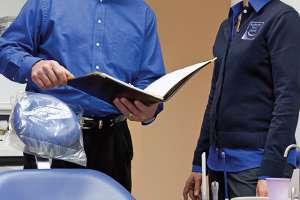
Sinclair took on another challenge in 1998 with the dental pollution prevention program. The program started before the New York State Department of Environmental Conservation (NYSDEC) passed a law in 2008 requiring amalgam separators in dental offices. In this role, Sinclair oversees a program that helps dental offices handle and dispose of wastes including mercury dental amalgam, fixer and lead.
“Dental offices are the number one source of mercury pollution from industry to wastewater facilities,” says Sinclair. “By installing amalgam separators, dentists are protecting the environment and Lake Ontario from these dangerous pollutants.”
Very small pieces of amalgam are released when a dentist places or removes a restoration. The fragments usually collect in the office’s wastewater, which goes into the public sewer system. Amalgam separators, installed in dental office plumbing, capture and remove at least 95 percent of the waste particles before they enter the sewers.
To get the word out, Sinclair worked with contacts he had gained over the years, and visited dental societies, associations and individual offices to tell them about the coming regulations. He knew his way around a dental office from his experience as a dental laboratory technician.
“I think this cooperative program is pretty unique to our organization,” he says. By getting buy-in from the dentists, we ended up being way ahead of the curve and very proactive.” The amalgam separator requirement quickly achieved 99 percent compliance, resulting in 67 percent less mercury load to the wastewater treatment plant.
In 2008, Sinclair helped start a pharmaceutical waste collection program that won the 2009 U.S. EPA Environmental Quality Award for the county, and the 2009 Environmental Excellence Award from the NYSDEC.
“In 2006, we started looking at the issue of pharmaceutical waste and its effect on the environment,” says Sinclair. “We requested permission from the NYSDEC to collect pharmaceuticals through our HHW collection program. NYS drug enforcement laws prohibited collection of pharmaceuticals, so there were no procedures in place to allow for the proper collection and disposal of this waste.”
Since the U.S. Drug Enforcement Agency (DEA), the NYSDEC and the state Department of Health could not agree on a procedure, Sinclair assembled a team to establish one. The team partners included:
• The Monroe County sheriff’s office to supply on-site law enforcement.
• The Center of Environmental Information (CEI) to help apply for an EPA grant for advertising the pharmaceutical waste collection.
• The Ruth A. Lawrence Poison and Drug Information Center, a clearinghouse for information.
• Clean Harbors for hazardous waste disposal.
• Wegmans Food Markets for pharmacists as expert resources.
• Action for a Better Community (a Rochester community services organization) for advertising assistance.
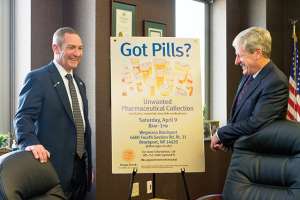
The team wrote a work plan to satisfy the legal and environmental agencies in the state, and it won approval from the DEC and Department of Health. “We give local law enforcement agencies assistance and provide all the paperwork,” says Sinclair. “They collect the waste, and we dispose of it by sending it to Covanta Energy in Niagara Falls, where they incinerate it as a community service free of charge.”
All medications and containers are incinerated under law enforcement supervision, as required by law. The program is free to all Monroe County residents for household medications only. Pharmaceuticals collected at drop-off sites, police departments and Wegmans Food Markets include prescription and over-the-counter medications, veterinary medications, and nutritional supplements. The county operates 80 to 100 collections per year, including those by law enforcement agencies and pharmacies.
Sinclair didn’t stop with Monroe County: He helped expand the program throughout the state, bringing together pretreatment coordinators, local and state regulators and municipal representatives to facilitate collections. Sinclair’s eagerness to share his experiences and help other municipalities led to more pharmaceutical collection sites throughout upstate and western New York.
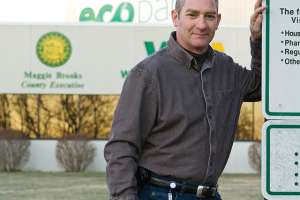
Sinclair’s newest project is the Monroe County ecopark, an all-inclusive recycling facility opened last September in a public-private partnership between Monroe County and Waste Management of New York. It collects HHW, pharmaceuticals, electronics, freon-containing appliances, tires, clothing, sharps and needles, cooking oil, metals, plastic wrap and bags, bulky plastics, and items that are part of the county’s curbside recycling program: paper, plastic, and metal containers.
“As a one-stop drop for our residents, this program is unique, and as far as I know, it’s the only one like it in the country,” Sinclair says. “It’s important to me, because I want people to think about what happens when they throw stuff away — how does it affect the environment?”
The project’s website (www.monroecounty.gov/ecopark) includes a Web-based tool that takes the guesswork out of determining which items are recyclable and where to deliver them.
All this work takes energy. “Being an innovator and a leader is what excites me,” Sinclair says. “One thing I strongly believe in is helping others. I meet a lot of different people in my job, within our department and outside agencies, and I get enjoyment out of being able to offer my skills to them.”
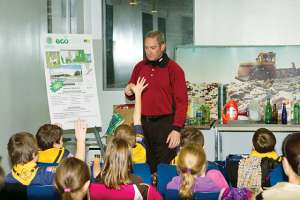
Sinclair shares his knowledge and his love of meeting new people by presenting at national and local conferences, such as the New York Water Environment Association (NYWEA), its Industrial Issues Committee, and the Solid Waste Association of North America (SWANA).
He coordinates a hazardous waste training program for county and municipal employees that trains about 185 employees a year. He also works with the county Office of Emergency Management for a local nuclear power plant’s congregate care center.
Outside work, Sinclair coaches for Odyssey of the Mind, an international program that provides creative problem-solving opportunities for children in kindergarten through college. He coached a team of sixth graders to the world finals in 2005. He also serves as assistant soccer coach and manager for girls’ soccer teams.
As for the future, Sinclair will continue to perfect the processes he has helped put in place, including the new ecopark. And, he will continue to share his knowledge: “I’m always open to new things, but right now I have no idea what the next big thing will be!”