To gauge the health of their treatment plant, Mike Fox and his staff just have to check with their fish. The North East Wastewater Treatment Plant in Conover, N.C., has an aquarium in its laboratory and two ponds on the grounds outside, both fed with plant effluent and stocked with fish and other aquatic creatures. Besides giving the staff a “miner’s canary” assessment of effluent quality, these features help show the public that the plant is protecting life in local waterways.
Monitoring quality
The original plant went online in 1991, serving Conover’s population of 8,016, spread over 10.2 square miles. Situated on 35.7 acres along Lyle Creek and three tributaries draining the Appalachian foothills, the plant processes about 0.75 mgd on average.
The 55-gallon aquarium receives a continuous flow of plant effluent. It is fed by tapping an effluent sampler line. The average flow rate allows about three minutes of detention time.
Fox, supervisor of wastewater treatment, got the idea from a trade magazine as an interesting way to monitor effluent quality. “My background was in marine studies, so I was interested in fish anyway,” he says. “When I saw that flow into the lab, it seemed obvious we could tap into it for the aquarium.”
The idea was that plant staff would know immediately from the fishes’ behavior if effluent was carrying an overload of residual chlorine or was deficient in some other way. “Well before it reaches a level that would be detrimental to the receiving stream, the fish will let us know,” says Fox.
“It’s probably the most valuable operational tool we have. We can walk by it any time of day and immediately see any escaping solids, unusual color, or turbidity. We weren’t sure when we put it in how it was going to play out or how valuable it would be. But now I could hardly operate a plant without it. It would seem like flying blind.”
The aquarium fish are all native species. Chubs, pumpkinseeds and darters are more hardy, while dace are fragile. Accustomed to high-dissolved oxygen from their native swift-water environments, dace are good environmental quality indicators. The tank also holds crayfish, frogs and salamanders.
Installing ponds
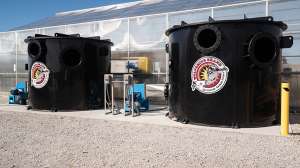
The old aeration basin was changed over to a pond in 1997 when the plant was updated with a sequencing batch reactor facility. A new clarifier was also added, creating two ponds. The effluent sampler and aquarium discharge about 20 gpm into the ponds.
A University of North Carolina satellite school in nearby Asheville offers a Ph.D. program in marine biology. Fox thought Conover might get the program interested in researching the fish that live in 100 percent effluent. “The aquarium is more of an acute look, while the basin ponds allow for a more chronic, long-term view,” Fox says.
From time to time, the aquarium fish would get a fungus-like growth that would rot their tails and cause lesions. Fox took samples to the university, where analysis revealed Columnaris, a bacteria that attacks fish that are injured or highly stressed.
The Conover lab staff noted the aquarium’s large fish were attacking the smaller ones, causing wounds that hosted the bacteria. They changed the size mix so that most fish are now of similar size, with no predators. They moved the larger fish to the ponds.
Pond species are not all native. “At first, I just got 50 goldfish,” recalls Fox. “Over a few months, they got huge and beautiful.” Once they grew to 6- to 8-inches in size, he took them back to the fish store and traded them for koi, which have been joined by channel catfish and bullheads.
Reaching out
That’s where outreach involving the ponds began. The Conover Police Department began staging its annual street fair in conjunction with the plant as part of public outreach to show off the SBR facility.
Private lawn ponds were becoming popular among residents, so Fox and his staff began giving fish from the ponds to the public as starters. This sent the message that plant effluent was clean enough to sustain sensitive life and generated public goodwill.
Fox’s crew grows water hyacinths that cover three-quarters of the ponds, helping keep the water clear and algae-free. “When it blooms, it’s incredible, with purple flowers all over the top,” says Fox. Public tour groups, including Boy Scout troops, summer campers, college students, state officials and foreign visitors can witness the pond’s beauty and see the fish.
The whole aquarium and pond setup cost just a few hundred dollars, funded from the operations and maintenance budget. No outside contractors were required. The only maintenance consists of regular cleaning. “With healthy water, you’re going to have things growing, so it’s a never-ending battle to keep algae out,” says Fox. “But it’s not a hard thing to do.”
Local newspapers have written about the project, and a Charlotte TV station featured the ponds and aquarium on its six o’clock news. “I like to think it helps a little to counter some of the bad press that makes it look like government doesn’t care or isn’t doing a good job,” Fox says.
“Acts of nature happen, and response may not always be what people expect. But with what we’re doing, people are seeing that we do try, that we do care, and that we’re quietly working every day to keep their water safe and clean.”