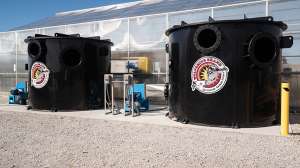
The Dane-Iowa Wastewater Treatment Facility in Mazomanie, Wis., is turning biosolids into a valuable commodity using a process that’s relatively new to the midwestern United States.
“We were the first plant in the northern part of the country to have this system,” says Richard McKee, facility superintendent. “All of the others were in the south.” The Schwing Bioset process used at the plant draws plenty of curiosity. It’s typical for McKee to receive four or five visitors per year and more phone calls asking about the process and his experience with it.
The Bioset process achieves Class A biosolids through time versus temperature equation and pH adjustment according to EPA 503 regulations. Quicklime and sulfamic acid are added to the biosolids, and the material is mixed and pumped through an insulated reactor.
The plant makes the finished product available at no charge to area farmers for land application. Advantages of the process to date include simple operation, low maintenance, consistent and stable Class A product, minimal dust and odor, and affordable cost.
Economy of scale
Putting biosolids to beneficial use was an important component during the plant’s design, but the economics had to be addressed.
The Dane-Iowa treatment plant in south central Wisconsin has a design capacity of 750,000 gpd. It receives influent from the villages of Black Earth, Mazomanie and Arena, and from Wisconsin Heights High School. But these sources alone would not generate enough biosolids to justify the cost of processing equipment. To up the volume, the Dane-Iowa Wastewater Commission made a deal to accept material from the Village of Cross Plains.
“We decided upfront to use the biosolids process, but with just three villages it wouldn’t be cost-effective,” says McKee. “We have a 20-year contract with the Village of Cross Plains to process their sludge. It’s the economy of scale.” It’s also a win-win solution, as Cross Plains, which wanted a solids-handling unit but could not afford it, now has a reliable biosolids management solution.
The front end of the Dane-Iowa plant uses relatively standard equipment. Mechanical screens remove coarse solids and plastics. Influent then flows to an orbital oxidation ditch, which does not require a separate primary settling basin.
Biological processes within the oxidation ditch remove BOD, phosphorus and nitrogen. This eliminates the need for primary clarifiers and in turn reduces the system footprint. The water from the oxidation ditch flows to two final clarifiers. Effluent from the clarifiers is disinfected using ultraviolet (UV) radiation before discharge to Black Earth Creek, a locally well-known trout stream.
Simple solids process
Solids are sent to a Roediger belt filter press and dewatered to about 16 percent solids. The end of the press marks the beginning of the Schwing Bioset process. “The dewatered sludge goes to a hopper, where quicklime and sulfamic acid are added,” says McKee. The material is then mixed by a twin screw feeder and delivered to the reactor by a piston pump.
“The amount of quicklime added is based on the percent solids coming off the filter press and the temperature of the sludge,” says McKee. “The lower the temperature, the more quicklime is needed. During the winter months, we add more.”
The quicklime is added in pebble-sized particles. Its introduction creates an exothermic chemical reaction that raises the temperature to hotter than 160 degrees F, while increasing the pH to at least 12, killing off pathogens.
Sulfamic acid is added in granular form. Through a proprietary process, the addition of acid moves liquid in the sludge mixture to the outer edges of the mass, where it acts as a lubricant, reducing the resistance and making the mixture easier to move through the pump and reactor. Because the process is enclosed within the reactor, it operates odor-free. The reactor discharge is the only place where gases can volatilize, and those gases are easily collected and deodorized with a small water scrubber. The final product has an odor similar to wet concrete.
The solids-handling process came online in June 2000. The original progressive cavity pump was ultimately replaced with a Schwing Bioset Model KSP-10H two-cylinder pump, originally designed to pump concrete.
“The stator on the progressive cavity pump was rubber-lined and was failing because of the abrasiveness of the lime,” McKee says. “As a result, we were not able to waste on a regular basis.” No permit violations resulted from the inconsistent operations.
“The new pump was installed in April 2008 and we haven’t had any problems,” McKee says. “It’s very reliable.”
Within parameters
In concert with the U.S. Environmental Protection Agency (EPA), Wisconsin requires quarterly sampling of the biosolids end product for metals, pH, percent solids and fecal coliform. The plant also must meet performance criteria for compliance with Class A standards. During processing, the material must maintain a temperature of 160 degrees F for 30 minutes.
“We have temperature probes throughout the reactor to make sure we have a sterilized product,” McKee says. “It’s continuous flow through the reactor. By the time it hits the second probe, it’s at 160 degrees. The detention time from the second probe to the end is 40 minutes.”
Solids are processed two days per week. The equipment runs for six to six-and-a-half hours, allowing time for startup and shutdown. Startup, operation and shutdown are all monitored by a programmable logic controller (PLC) connected to the plant’s SCADA system. Startup and shutdown are handled at the push of a button. At startup, measurements must be taken to determine the dosing of the sulfamic acid and quicklime.
“We come in in the morning and run the process control test to determine the temperature and percent solids,” says McKee. “Then we calculate the belt filter press and lime loading rate. We have our data to go by, but we can fine-tune it. If nothing changes, the system can be pretty much left unattended. All we do is check on it.”
Quality product
The processed biosolids is a valued commodity in the farming community. It contains about 40 percent hydrated lime and 60 percent inert matter and organic humus. It does not smell and, in keeping with Class A status, does not attract rodents or flies.
Farmers report that the biosolids react quickly with the soil, changing the pH within 60 to 90 days of being applied. The organic material helps stabilize the soil, increasing its ability to store nutrients and water. Plant staff members collect samples regularly to ensure compliance with Class A criteria and to provide farmers with concentrations of trace metals, nutrients and other parameters.
Employees at the Dane-Iowa treatment plant recommend the amount of material to apply. Most farmers land-apply the material in spring and late fall. It’s not uncommon for one farmer to haul off 200 to 300 tons.
“We can tell the farmers how much they need,” says McKee. “A simple soil test is all that’s needed for farmers to zero in on their lime requirements. The pH really determines how much can be applied.”
The plant produces about 800 tons of biosolids per year, all available to local farmers free on a first-come first-served basis. The treatment plant takes no responsibility for transporting the material from the facility or applying it to the fields.
Workers at the plant move the material to an on-site storage building using a front-end loader. Farmers use that machine to load their trucks or bring their own equipment. “We have one farmer who owns his own equipment and several who hire people to come and get the material,” McKee says. “We end up with a little bit of fuel cost, but not much.”
Final destination
Once at the farms the biosolids are spread on the fields using a side-slinger spreader. McKee doesn’t recommend a typical manure spreader because it causes clumps. The side-slinger breaks up the material. The plant has a three-sided building that provides 180 days of storage capacity — land application is not allowed in winter.
Employees at the Dane-Iowa plant can attest to the quality of their product. “We used the biosolids on a test garden out here,” McKee says. “We grew potatoes, carrots, tomatoes, onions and string beans.” They not only produce a quality product — they’re farmers to boot.