Makedown System
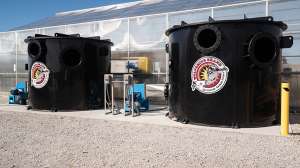
The explosion-proof polymer makedown system from Fluid Dynamics Inc. prepares, activates and injects liquid polymers in wastewater treatment applications. At 20,000 to 30,000 gallons per hour, the system produces 0.1 to 2.0 percent dilute solutions.
Besides stainless steel construction, units have the Gatlin Mixer, a motorized mixing chamber that segments the polymer into ultra-thin film for maximum activation regardless of fluctuating flow rate or water pressure. An interlock prevents polymer feed if water flow is insufficient. Standard systems include manual or automatic electronic metering pumps for polymer injection. Larger models use motor-driven metering or progressive cavity pumps. Acces-sories include a desiccant breather, calibration column kit and drum mixer. 888/363-7886; www.dyna blend.com.
Solid-liquid Separator
The high-flow IFRS 36 separator from Accent Manufacturing Inc. is a 36-inch rotary stainless steel screen for thickening and dewatering. Available in 3/4-hp electric or hydraulic drives, the friction drive system uses rubber-coated stainless steel wheels for positive traction and long life. The automatic cleaning system prevents clogging and ensures consistent flows. A bypass chamber, variable speed control, high-torque starting, and Delrin bearings eliminate flow control valves, maximize flow, optimize dewatering, and reduce maintenance and operating costs.
Simple to install, the separator operates manually or automatically. As a permanent receiving station, it reduces waste sludge costs by 30 percent. In its mobile configuration, the separator removes inorganic and nonbiodegradable materials from septage and digester waste. 877/855-4890; www.accentmanufacturing.com.
Dry Filter Cakes
Quadra filter presses from Ascension Industries Inc. dewater biosolids with fully automatic or manual operation, producing dry filter cakes that reduce weight and lower transportation costs. A durable design provides years of service in corrosive environments. 716/693-9381; www.asmfab.com.
Solids Conditioning
The FTXL model belt filter press from Frontier Technology Inc. has a gravity solids conditioning zone, radial wedge section and optimal pressure roll section. Auxiliary equipment includes nip rolls, polymerization systems, pH balancing systems, sludge infeed, and discharge equipment with fully integrated controls. 269/673-9464; www.frontiertechnology.net.
Vapor Phase Adsorber
Wolverine HDPE-42 vapor phase carbon adsorbers from Simple Solutions Distributing LLC provide economical, effective odor control for convection or forced draft ventilation flows up to 500 cfm in applications including solids press rooms. Factory-assembled corrosion- resistant vessels require only an electrical hookup and inlet piping to the odor source. They hold 800 pounds of regular carbon, 1,000 pounds of caustic carbon (impregnated), and 800 pounds of catalytic carbon.
With the proper media, units treat hydrogen sulfide, mercaptans, ammonia and common wastewater odors. In normal use, the media lasts about a year. At change-out, operators remove the lid, vacuum out the spent filter bed, and refill. Vessels secure to a skid or concrete slab with mounting tabs. Options include pressure blower, control panel, industrial skid, rain cap and various carbons and granular potassium permanganate. 866/667-8465; www.industrialodorcontrol.com.
Mechanical Screening
Hydro-Flo mechanical screens from Hydro-Dyne Engineering have openings from 1 mm to 3 inches in stainless steel laced links, woven mesh or perforated panels. Very low head losses and stainless steel grids make these center-entrance, side-discharge screens suitable for numerous applications. Models, available in 24, 36, 48, 60 and 72 inches, handle low to high flows and incorporate into Hydro-Dyne septage receiving stations. 813/818-0777; www.hydro-dyne.com.
Dewatering Box
An ADS 30-yard open-top roll-off dewatering unit from Aqua-Zyme Disposal Systems Inc. replaces six standard drying beds. The filter container processes 22,000 to 25,000 gallons of sludge, septage or grease trap waste at 1.5 to 2 percent solids in about two hours. Dewatering reduces volume by 80 percent and BOD, COD, FOG and TSS by 98 percent. Clear effluent can return to the head of the plant. After draining the unit for 24 hours, workers can empty it at a landfill or composting facility. 979/245-5656; www.aqua-zyme.com.
Mobile Dewatering
Fluid Technology Inc., a mobile contract dewatering service, sizes the proper equipment for each project to deliver maximum efficiency and minimum disruption to workforces. Staffed by professionals, the company’s 1.7- and 2.2-meter mobile presses operate in most climate conditions without significant loss in production. 888/844-7824; www.fluidtech nologyinc.com.
Turnkey Systems
Prepackaged on self-supporting skids or trailer-mounted for quick, portable operation, belt filter presses from Bright Technologies, a division of Sebright Products Inc., exceed the requirements of municipal applications. Frames, rolls and pans are 304 stainless steel. A radius wedge and drainage roll allow for higher throughput and increased total output.
The first large-diameter fabricated pressure roll has 50 percent open area drainage for the upper and lower belts. As the drainage roll rotates upward, it channels water to the outside, washing out solids so they do not impede drainage in subsequent operations. The wing roll also cleans easily. The pneumatic steering and tensioning system is safe and easy to operate. The programmable logic controller and touchscreen controls integrate with SCADA systems. Ancillary equipment includes a rotary lobe solids pump, belt wash booster pumps, air compressor, polymer system and solids meter. 800/253-0532; www.brightbeltpress.com.
Equipment Protection
In-line Muffin Monster grinders from JWC Environmental shred large rags, rocks, plastics, trash and other solids into tiny particles that flow harmlessly through pumps, pipes, digesters, centrifuges, belt presses and dewatering equipment. The homogenous particle size enhances the efficiency of centrifuges. Design improvements in the dual-shafted units include a unibody housing and hex-shaped mechanical seal. 800/331-2277; www.jwce.com.
Rotary Press
Prime rotary fan presses from Prime Solution Inc. are compact, efficient units with low maintenance and operating costs. The continuous dewatering process is totally enclosed, eliminating odor and reducing corrosive exposure to nearby equipment. Self-contained skid, mobile and modular units require little supervision and have a semi-automated self-clean cycle. They install easily, and lower utility requirements cut building costs. Presses are available with 18-, 24-, 36- and 48-inch screens.
The process flow is controlled from inside the press. Material moves slowly toward the outlet, forming a cake. An adjustable, two-piece pneumatic restriction plate controls pressure at the outlet. The frictional force of the slow-moving filter plates and controlled outlet restriction produces cakes as dry as 60 percent solids. 269/673-9559; www.psirotary.com.
Long-term Dewatering
KLAMPRESS belt press technology from Ashbrook Simon-Hartley is designed as a cost-effective and versatile dewatering process to adjust to the changing character of biosolids streams. A zone approach makes the technology effective with softer sludges that result from advanced treatment processes. Modular design allows easy modification, such as the retrofit of additional pressure zones or odor-control components. Systems are available with an independent gravity deck that allows independent operation of gravity belt thickening and belt filter press operations. A three-belt configuration saves space and significantly increases capacity. 800/362-9041; www.ashbrookcorp.com.
Efficient Dewatering
The model NT-8000E dewatering container from NewTech Inc., is made of mild steel. It is equipped with 750 micron filter screens along both sides and a double screen down the center, mounted on a steel frame. The filter screens allow water forced from the solids by the flocculation process to flow through and out the drain ports in the bottom front.
The screens hold the solids in the container for later disposal. A full-width (hydraulic open/close, lock/unlock) rear door allows dumping of the solids after dewatering is complete. The rear door is equipped with 4-inch drains to aid in wash-up and to discharge partially dewatered sludge. A filler pipe, through which the container is charged with material, is located on the front. All ports are threaded to NPT standards. An attached ladder gives easy access to the top of the container.
The container can be tilted to dump loads. The mild steel is sand-blasted, primed and coated on the inside with an epoxy and outside with the color specified. Dimensions are 20.4 feet long, 8 feet high, 8 feet wide. The unit weighs 6,000 pounds. 800/210-2361; http://dewater91.com.