Industrial water tanks are vital for ensuring safe drinking water, but they are constantly exposed to moisture and temperature fluctuations that lead to corrosion. Corrosion weakens the tank structure, increases maintenance costs, and risks water contamination. To prevent or solve these issues, selecting the right coating is crucial. According to multiple sources, corrosion costs approximately $450 billion annually in the U.S. alone.
“The first step is assessing the project: are you working with a new tank or an existing structure?” says Matt Elden, business development director for Advanced Rehabilitation Technology (ART) and OBIC, with nearly 25 years in the coatings industry in formulation and sales. “With a new tank, its internal condition is more predictable, but an older tank requires a thorough evaluation. You also need to consider the expected life span you want from your investment. Another often understated, yet equally important, consideration is the surface preparation of the structure. The key to the coating working as it should is making sure the substrate is prepared appropriately.”
Epoxy advantages and limitations
Both epoxy and polyurea are two-component coating systems; so which one is better? That answer has a lot to do with the expected environmental fluctuations (like temperature and humidity) during the tank’s expected service life, as well as at the time of application. Epoxy coatings create a hard, protective layer that resists chemical exposure and corrosion. Epoxy coatings, when totally cured, create a very rigid coating with excellent crosslink density. This is great when you know the structure won’t move. Additionally, epoxies are sometimes specified at thinner film builds. With everything else equal, a higher film build (often dubbed DFT, or dry film thickness) will give better corrosion resistance.
Advantages of epoxy
- Strong adhesion – Bonds well to properly prepared surfaces, providing effective protection
- Chemical resistance – Withstands exposure to many water treatment chemicals
- Proven track record – Decades of use in water tank applications
Limitations of epoxy
- Long curing time – Can take days to fully cure, delaying return to service
- Rigid composition – Prone to cracking, chipping and wear when subjected to movement or temperature changes; freeze/thaw cycles can be especially detrimental
- Environmental susceptibility – Can be more susceptible to wear in very acidic or low pH environments, as well as continuous exposure to grit and sand
Polyurea advantages and limitations
Polyurea coatings have gained popularity due to their flexibility, rapid curing time, and enhanced resistance to environmental factors. Unlike epoxy, polyurea remains elastic (due to its different chemical makeup), making it ideal for tanks exposed to structural movement or extreme weather conditions. “In our experience, tanks are living, breathing structures that are expected to last a very long time,” Elden says. “We believe that lining these tanks with a more flexible coating option can be extremely beneficial to keeping long term maintenance costs to a minimum.”
Advantages of polyurea
- Fast curing time – Dries in about 30 seconds, allowing tanks to return to service quickly
- Superior flexibility – Withstands structural shifts and avoids microchipping
- High chemical resistance – Protects against water treatment chemicals and contaminants
Limitations of polyurea
- Specialized application – Requires trained professionals for proper application
- Higher initial cost – Could be more expensive upfront but can lead to long-term savings due to less maintenance
“Industrial water tanks must be taken out of service during rehabilitation, temporarily cutting off water access for those who rely on them,” Elden says. “This makes a quick return to service an important factor in the coating selection process.”
Why choose polyurea over epoxy for industrial water tanks?
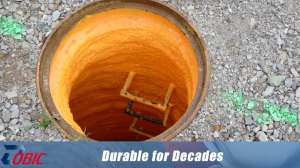
For applications where the substrate is prone to movement or flexing, epoxy may not be the best choice. This is where polyurea becomes the preferred solution. “In the manhole repair space, we’ve seen thousands of cases where epoxy coatings failed due to freeze/thaw cycles and environmental stress,” Elden states. “Because manholes are underground, they experience extreme conditions that can cause epoxy to crack and deteriorate. Municipalities often reach out after just a year or two, reporting epoxy failures and requesting polyurea as a more durable solution. While epoxy coatings may hold up if they survive the initial freeze/thaw cycle, polyurea offers a proven, long-term performance advantage.”
Polyurea may be the best choice if return to service is a primary concern. Elden says that municipalities prioritize getting potable water tanks back into service as quickly as possible, as downtime creates major challenges for plant superintendents and maintenance operators. This is where polyurea provides a significant advantage. While epoxy coatings may take one to two days to fully cure, polyurea cures in just 30 seconds — dramatically reducing downtime and ensuring a faster return to service. This rapid cure time makes polyurea a game-changer for that.
Research is key
“If I was a plant superintendent making this decision, I’d consult multiple contractors and coating manufacturers to explore all available options,” Elden recommends. “Rehabbing a potable water tank is a significant investment, one of the largest you’ll make outside of building new. Taking the time to research all your options ensures confidence in the chosen solution. Many companies and contractors are more than willing to provide guidance and educate you on the best approach for your specific tank configuration. When you’re pricing out your project, you also want to compare apples to apples on a dry film basis, because at the end of the day, the dry film that protects the substrate is what you’re paying for.”
The OBIC advantage
OBIC’s 1100 aromatic polyurea coating is typically used for potable water containment, water treatment, industrial facilities, food processing plants, and bottling/canning plants. It will not be susceptible to cracking or microcracking and it can bridge any cracks you might have in the substrate. Plus, it provides quick return to service and has superior elongation and flexibility. Investing in the right coating today can extend the life of your water tank and reduce future maintenance costs, making polyurea the smart choice for long-term protection.