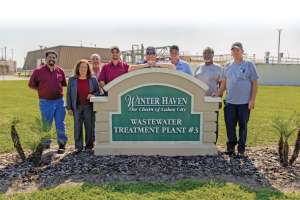
A small community contacted Florida Gateway College with a concern about 1, 4-dioxane, a new pollutant that has been found in water supplies in California, New Hampshire, Colorado and North Carolina. Community leaders explained that their treatment plant tests for only a fraction of the chemicals in use today.
If a water treatment facility’s team members know what is in the raw water, they can test for and remove it. However, many chemicals can contaminate water supplies, and it is not feasible to test for all of them. Wellhead protection plans and sanitary surveys are conducted to identify sources and types of pollutants and to prevent pollution from occurring.
The pollutant of interest to this community, 1, 4-dioxane (often called simply dioxane) is a heterocyclic organic compound — a colorless liquid with a faint sweet odor. Classified as an ether, it has been used mainly as a stabilizer for the solvent trichloroethane and occasionally as a solvent for various applications. Legislation in the 1990s aimed to phase out trichloroethane through the Clean Air Act and the Montreal Protocol. Since then, production of dioxane as a stabilizer has decreased. Today, it is primarily used as a solvent for cellulose, organic products, lacquers, paints, cosmetics, deodorants, emulsions and adhesives.
Impacts on groundwater
Dioxane is irritating to the eyes and respiratory tract. Heavy exposure (significantly higher than in commercial products) can cause damage to the central nervous system, liver and kidneys. Accidental worker exposure to dioxane has caused several health problems. Dioxane is classified as a possible human carcinogen and is a known carcinogen in animals. The greatest health risk from dioxane is associated with inhalation of vapors.
We explained to the community leaders that dioxane has affected groundwater supplies — it has been detected at or above 1 part per billion in many locations in the U.S. In New Hampshire, it was found at 67 sites in 2010 in concentrations from 2 ppb to more than 11,000 ppb. Thirty of these sites were solid waste landfills, most of which had been closed.
Dioxane is highly soluble in water, does not readily bind to soils and readily leaches to groundwater. It is also resistant to natural biodegradation. Because of this, a dioxane plume is often much larger and farther down gradient than the associated solvent plume.
In 2008, testing found dioxane in almost half of tested organic personal-care products. Since 1979, the Food and Drug Administration (FDA) has tested cosmetic raw materials and products for dioxane. It was present in certain ingredients at up to 1,410 ppm and in finished products at up to 279 ppm. Levels exceeding 85 ppm in children’s shampoos indicate that close monitoring of raw materials and finished products is warranted. The FDA encourages manufacturers to remove dioxane, but they are not required to by federal law.
In 1992, 1.13 million pounds of dioxane was released into the U.S. environment, about 60 percent to the air, about 40 percent to surface waters and less than 1 percent onto land. It has been detected in surface water, groundwater and wastewater treatment plant effluents.
Emerging contaminant
Inhalation is the most common route of exposure to dioxane, but exposure may occur through contaminated food and water or through contact with skin. Exposure in tap water through inhalation during showering can result in higher exposures than ingestion through drinking water. Acute side effects include irritation of the eyes, nose, throat and lungs; drowsiness; vertigo; headache; and anorexia. Human and animal studies identify the liver and kidneys as the target organs for dioxane toxicity. Chronic exposure may result in dermatitis or liver and kidney damage. The reproductive effects are unknown.
The EPA classifies dioxane as an emerging contaminant and includes it in the third Drinking Water Contaminant Candidate List. It is also a proposed contaminant for the third Unregulated Contaminant Monitoring Rule program. In 2004, Colorado became the first state to establish an enforceable cleanup standard for dioxane in groundwater and surface water. The standard, being phased in, required facilities to meet a 3.2 ppb limit by 2012.
Pump and treat remediation is the primary method used at sites contaminated with dioxane. Advanced oxidation processes involving hydrogen peroxide with UV light or ozone are used to break down the chemical. Breakdown products include aldehydes and organic acids. Other remediation treatments include photocatalysis and soil vapor extraction. Dioxane is not well controlled by adsorption onto activated carbon and is not readily removed by air stripping. It is not well degraded by typical soil microorganisms.
Effective treatments
Several treatments are effective for dioxane removal; some remove more than 99 percent under specific conditions. Advanced oxidation processes such as ozone combined with hydrogen peroxide, UV light combined with titanium dioxide, UV light combined with peroxide, and hydrogen peroxide combined with ferrous iron are the most effective treatments. Atypical treatments that show promise include biological treatment and biofiltration with added microbes, corona discharge, gamma irradiation and sonication.
Aeration, chlorine disinfection, permanganate addition, conventional treatment, hydrogen peroxide addition, ozonation, powdered activated carbon and UV irradiation alone have been ineffective at removing dioxane. Adsorptive media is also ineffective; aeration and air stripping can remove 3 percent of the contaminant. Biological filtration using an aerobic bacterial strain, like P. dioxanivorans, can remove 93 percent, granular activated carbon 20 percent, reverse osmosis can remove 96 percent and nanofiltration 48 percent.
College representatives encouraged the community leaders to test for dioxane to determine whether it is a contaminant that merits local attention. The most probable source in their area would be wastewater effluents.
About the author
John Rowe, Ph.D., is a professor of Water Resources at Florida Gateway College in Lake City, Fla. He can be reached at john.rowe@fgc.edu.