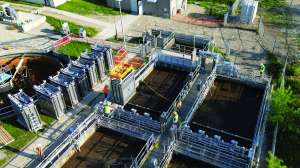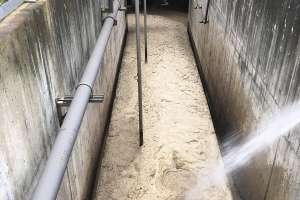
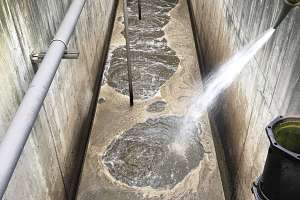
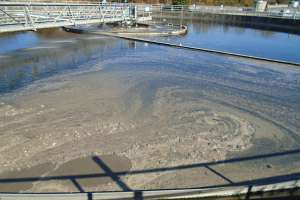
The aeration basins at West Point Treatment Plant in Seattle experienced periodic foaming caused by nocardiaform filamentous bacteria.
Although the foaming problem did not significantly affect significantly secondary effluent quality, it made process control more difficult by acting as a barrier for oxygen transfer to the bulk liquid. It was also linked to digester foaming, which proved harder to control. Digester foam can overflow the cover, cause pumps to become gas-bound and reduce digestion capacity.
Plant staff found it prudent to solve the problem at the source instead of downstream. Accordingly, they tested control of secondary process foaming through the addition of a cationic polymer to the return activated sludge. The result indicated that the polymer applied could reduce foaming in both the aeration basins and the digesters.
Seeking solutions
The West Point plant is a combined sewer overflow treatment facility with an average annual design flow of 133 mgd and a maximum instantaneous flow of 440 mgd (300 mgd for the secondary treatment process).
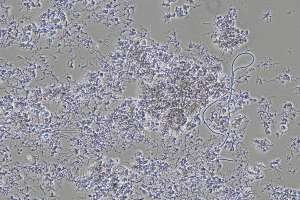
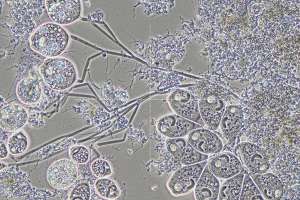
The facility uses a high-purity oxygen aeration process. Therefore, the aeration basins are covered and inaccessible to retain high-purity oxygen in the headspace. This configuration traps the filament generated in the basin and allows it to multiply when growing conditions support it. Microscopic analysis confirmed that nocardioform filament — a branched, hydrophobic filament that traps air and solids in the air bubble — was causing the foaming.
Several methods had been tried to reduce foaming, including as maintaining low sludge age and increasing oxygen flow. Although these helped to curb the effects of the foaming at times, they did not remove the existing foam formed in the closed basin.
The plant’s average sludge age is two to three days, already lower than for typical activated sludge plants. Reducing the sludge age to below 1.5 days would reduce solids removal efficiency, as the return and waste activated sludge might be thinner. The sludge age is kept at two days or less during the polymer addition trial described below. Physical removal of the foam is also useful but the only way to skim the foam off was from two 2-foot-wide mixed liquor basin gates.
Polymer trial
The addition of cationic polymer to control secondary foaming had been used successfully at the San Jose/Santa Clara (California) Water Pollution Control Plant (Lemma et al., 2010) and at several other plants across the United States.
It had been suggested that the cationic polymer “can solve the Nocardia foaming problems by reducing the surface tension created between air bubbles and Nocardia-enriched floc that allows Nocardia to pass through the aeration basins to eventually escape the sludge treatment system.” (Shao et al., 1997).
The West Point team conducted a RAS polymer addition trial to test whether that method could help reduce and eliminate the foam caused by nocardioform filaments. The cationic polymer used by San Jose/Santa Clara is similar to the dewatering polymer used at West Point. Therefore, the dewatering polymer was selected for the trial.
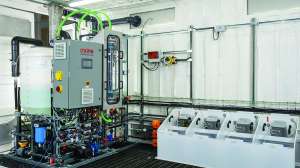
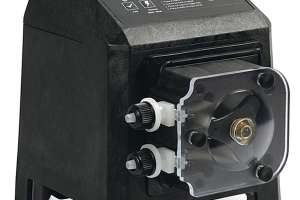
A polymer blend skid provided by the polymer vendor was used to dilute the polymer in-line and dose it directly to the suction side of a RAS pump. One drawback is that the West Point plant has separate RAS pumps for each of its 13 clarifiers. For the trial, the diluted polymer was added to the suction side of one RAS pump suction side in the middle of the RAS trunk line.
Observing outcomes
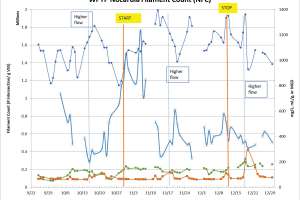
The foaming usually occurs during shoulder seasons (when the weather conditions transition from spring to summer or fall to winter). The trial was conducted during a significant foaming episode from October to December 2019. The active cationic polymer dose was increased from 0.5 to 1 mg/l each day for six weeks. The maximum dose was limited to the dilution water flow rate.
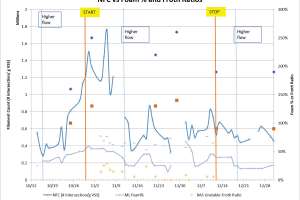
A Nocardia filament count method via microscopic analysis was used to quantify filaments in the system as the number of intersection/grams of mixed liquor volatile suspended solids (Jenkins et al., 2004). The counting was conducted every weekday. The NFC trend over time is shown in Figure 1. Sludge volume index and secondary influent flow are included in the graph for reference.
There was an increase of NFC and SVI directly after the addition of the polymer. However, both were trending downward after a week (two to three times the plant’s sludge age). A significant reduction in mixed liquor foaming was visually observed after the polymer dose of ≥0.75 mg/l. There was a short NFC peak after the high flow, as the flow pushed the foam formed in the closed aeration basin to the mixed liquor channel.
After the trial started, a reduction in digester foaming was also noticed. To quantify the foaming degree in the digesters, a frothing potential test was conducted regularly on sample of digester sludge. Figure 2 shows the NFC versus frothing ratios for RAS and digester samples as well as the Mixed Liquor East basin foam coverage (ML foam %). The unstable froth ratio measures the maximum foaming potential, while the stable froth ratio measures the settled stable foaming potential.
Drawing conclusions
From the initial trial, it is apparent that adding cationic polymer to the RAS line can help reduce the foaming filaments in the secondary treatment process.
Based on discussions with New York City Department of Environmental Protection personnel, higher polymer dosage fed for a shorter period is recommended to eliminate the foaming in the secondary process. However, at the test location, the amount of water available for polymer dilution was limited. Further modification to increase the dilution water flow is required before continuing the trial at a higher dose.
No adverse effects on secondary treatment from the polymer addition were noticed during the trial. However, bench tests showed that overdosing the polymer might create floating solids during the settling test. Closer monitoring is recommended while using this method.
It should be noted that extra caution should be practiced when working with polymer. Polymer creates a slick and slippery solution when combined with water. Secondary containment is required for the dosing and storage equipment for safety purposes.
The initial cost analysis showed that adding polymer to the RAS line is a cost-effective option for foaming mitigation. The West Point plant had been adding biodegradable defoamant to mitigate foaming in the anaerobic digesters (both initial and maintenance dose applications). The cationic polymer price per pound is significantly lower than defoamant price, and so it is a more preferable option.
This method also reduces the impact of foaming before it reaches the solids process, which also reduces operators’ time to clean up foam overflow at the mixed liquor channel or digester covers and to backflush gas-bound digester mixing pumps.
Further tests are needed to evaluate whether higher polymer doses (with higher dilution water flow) can eliminate the foam in secondary process. One treatment plant staff member suggested that a higher dose be applied in the first few days, approximately one sludge age, to observe whether a more significant improvement occurs. The staff intends to test that in the next season.
About the author
Jessica Tanumihardja (jessica.tanumihardja@kingcounty.gov) is a process analyst II with the King County (Washington) Wastewater Treatment Division’s West Point Treatment Plant.
References:
Jenkins, David, Michael G. Richard, and Glen T. Daigger. 2004. Manual on the Causes and Control of Activated Sludge Bulking, Foaming, and Other Solids Separation Problems. Boca Raton, FL: CRC Press.
Lemma, Issayas T., Alex Ekster, Dale Ihrke, and Kingsley Okeke. 2010. Polymer Addition Combined with Rapid Decrease in Solids Retention Time Is an Effective Nocardia Foam Control Method. Proceedings of the Water Environment Federation 2010 (16): 1101–9. doi:10.2175/193864710798158832.
Shao, Y. J., Mark Starr, Kosta Kaporis, Hi Sang Kim, and David Jenkins. 1997. Polymer Addition as a Solution to Nocardia Foaming Problems. Water Environment Research 69 (1): 25–27. doi:10.2175/106143097x125146.
Pitt, Paul, and David Jenkins. Mar.-Apr. 1990. Causes and Control of Nocardia in Activated Sludge. Research Journal of the Water Pollution Control Federation, 62 (2): 143-150.
Mamais, D., A. Andreadakis, C. Noutsopoulos, and C. Kalergis. Causes of, and Control Strategies for, Bulking and Foaming in Nutrient Removal Activated Sludge Systems. 1998. Water Science and Technology 37 (4-5). doi:10.1016/s0273-1223(98)00078-x.