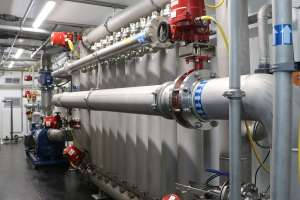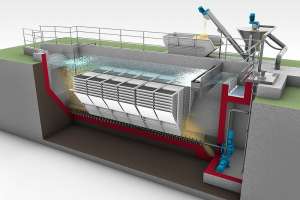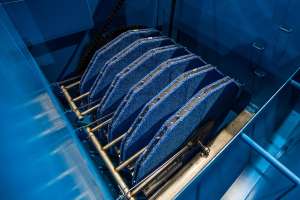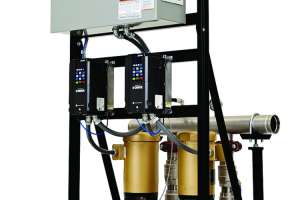
A mobile wastewater treatment system built at NASA’s Kennedy Space Center in Florida that can help prepare for long-duration missions on the Moon and Mars recently departed the spaceport and arrived at the University of North Dakota in Grand Forks. Graduate students at the university will test the technology under conditions designed to closely mimic the challenges of operating on another planetary surface.
The Divergent Deployable Wastewater Treatment Facility is designed to turn crew wastewater into useful resources that future explorers will need every day. At the University of North Dakota, teams will integrate this new wastewater system with the university’s Integrated Lunar/Martian Analog Habitat. Student operators and NASA researchers will study how the facility performs when connected to a habitat-like environment and is exposed to the kinds of operational limits crews could face on another planet.
“NASA’s Artemis program is laying the groundwork for a sustained human presence on the Moon, where habitats will need to operate far from the steady resupply chain that supports astronauts in partial gravity,” says Luke Roberson, surface water systems lead within the Mars Campaign Office at NASA Kennedy. “To solve that challenge, we are developing the future of sustainable lunar surface systems to process wastewater into nutrient feedstocks for plants and biomanufacturing.”
Read about how the system works here.
NYPD Investigates Groups of People Sneaking Into Manholes
The New York City Police Department is actively investigating after two separate groups of people were caught sneaking into Brooklyn sewer systems in the late night and early morning hours. In the first incident, at least seven individuals spent roughly three hours underground near McDonald Avenue and Colin Place in Gravesend. Just a few hours later and eight miles away near Heyward Street and Bedford Avenue, another eight people climbed down a manhole, eventually surfacing just before 4 a.m. to flee in a vehicle.
Emergency responders quickly swept both locations and confirmed the municipal infrastructure remained secure and hazard-free. Following the all-clear, DEP officials issued a stern public reminder that exploring the city's pipe network is both illegal and dangerous, as trespassers risk exposure to lethal gases, flooding and unstable underground conditions.
Operator Finds Ball Python in Canada Treatment Plant
A 1.07-meter ball python is currently recovering at the Windsor/Essex County (Ontario) Humane Society after a startling discovery at an east Windsor wastewater treatment facility. The chief operator at the plant stumbled upon the reptile inside a "rag bin" nearly 7.6 meters underground. The snake had initially appeared on the plant's inlet screens before independently climbing into the bin, miraculously avoiding the facility's hazardous cleaning machinery.
While it remains unclear exactly how long the python survived in the subterranean sewer network, City of Windsor pollution control executive director Ed Valdez noted the frequently inspected area means the snake hadn't been trapped in the bin for very long. Valdez suspects the wayward pet likely escaped a local residence before slipping into a neighborhood curb catch basin.