“SAS (surplus activated sludge) is a bit weird and can do odd things,” says Stuart Chatten, lead bioresources technician at Whitlingham Water Recycling Center (WRC), one of Anglian Water’s principal centers for processing sewage, serving a population of 400,000.
Those weird and odd things — including a thickness that can often prevent it from moving down pipelines like water or normal sludge — means that it can stubbornly stick, causing pumps to run dry, backing up tanks. Understandably, the handling of SAS at Whitlingham wasn’t top of the favorites list for maintenance teams.
Well, that’s just how things were until recently at Whitlingham WRC, where SAS was constantly winning the battle versus pumps. Instead of the pumps evenly drawing down SAS from two 20 cubic meter storage tanks, the challenging consistency of the sludge would lead to one tank emptying quicker, making the pump suck air while the other tank remained almost full, getting thicker and thicker, causing high levels of mixed liquors.
For Stuart and his team, the daily morning huddle meeting always drew a groan because it included the now all-too predictable, irritating chore of having to sort out "those SAS pumps."
“To thin the tanks out, in order to get everything moving, one of our team would have to put some water through the pumps to prime them,” he says. “The problems caused with the pumps not handling the SAS properly meant that instead of a baseline figure of around 4,500 mg per liter, all the stop/start we were enduring saw levels up at more like 4,500 to 5,000 mg per liter, which was way too high. We could never get ahead.”
Understandably frustrated by the sorry sustained SAS situation, Stuart turned to a supplier whose pumps had actually been on the Whitlingham site since 2012, including one (close to the SAS operation) for a poly-dosing application.
“The first Boerger pumps here fed the sludge belt press,” says Stuart. “A further order was placed in 2015 for digester mixing pumps. These two sets of pumps from Boerger had never let us down, plus we’d always had good back up from the company, so we took a look at what else they had to offer.”
Finally, two Boerger PL200 pumps were brought in to replace the existing SAS units.
“It is virtually an automatic system that maintains our compliance and pretty much looks after itself,” says Stuart. “We no longer have to keep talking about them.”
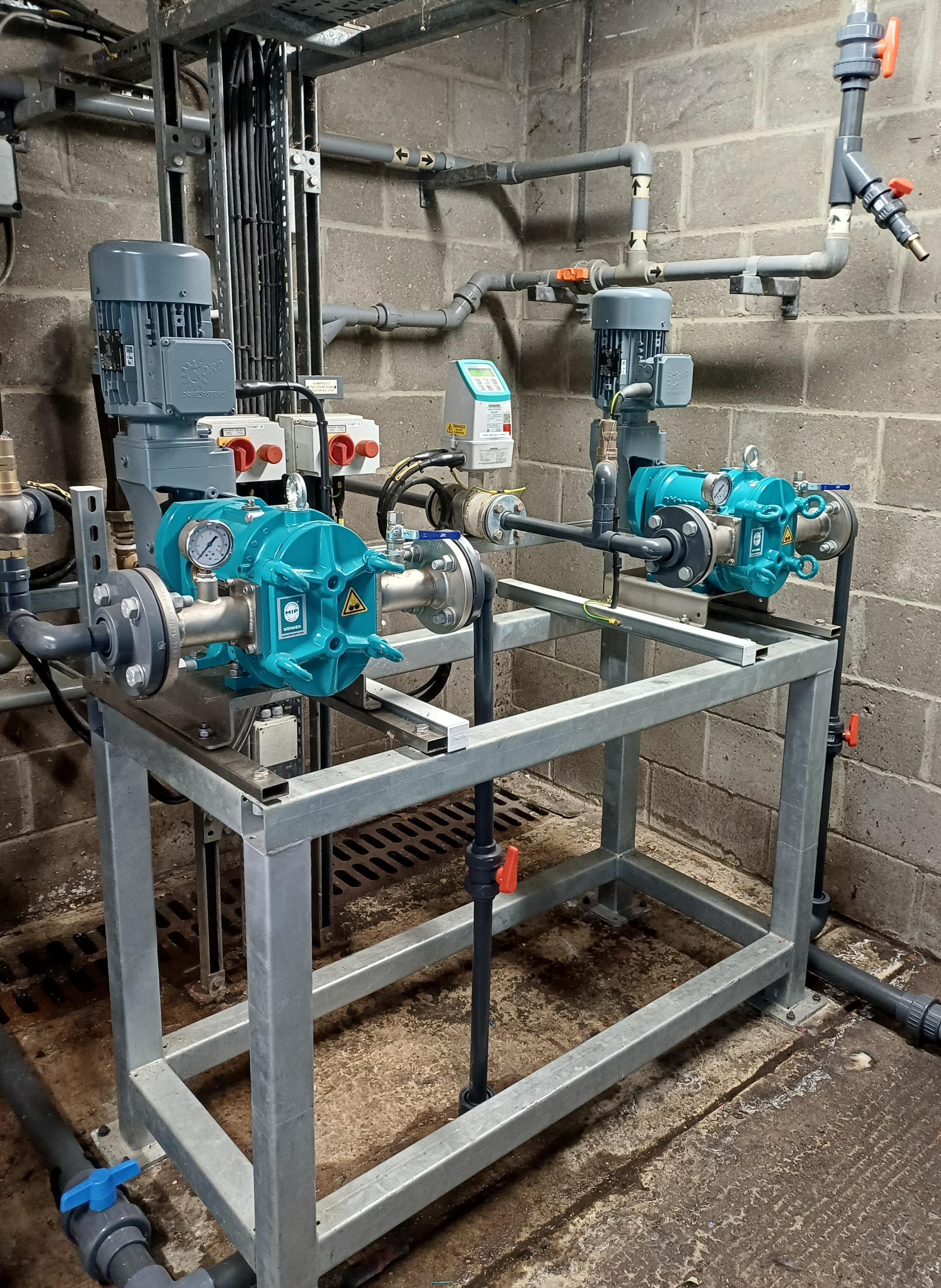
Another unpopular task at Whitlingham was the servicing of the polymer-dosing pumps. The only exception was a Boerger AN040 that had been installed on trial.
“For the existing pumps, we were having trouble getting spare parts from the manufacturer, so we couldn’t carry on like that,” says Stuart. “Also, the pumps’ position at floor level made them very time-consuming and awkward to maintain. The pumps were also positioned all too tight together. There was pipework coming and going everywhere at all angles. It wasn’t easy, and it could be messy too. The exception was the Boerger unit, which had never skipped a beat. It was a no-brainer to switch to Boerger. We now have a total of six.”
The very compact Boerger BLUEline pump models for the polymer dosing are AN040s, designed with space for almost any sealing system.
“Everything now is nice and even, though they’ve never been rough anyway. These new Boerger models bring a whole new level of smoothness, delivering a far more consistent mix, and with the added benefit of us slightly reducing the amount of polymers that we use.”
Pumps from Boerger are also set to play a key role in the expansion at Whitlingham as a sludge treatment center, with replacement of digesters that were built in the late 1950s. CL390 and PL200 Boerger pumps will be part of new processes for Anglian Water’s planned doubling of the WRC’s sludge capacity to serve one million people.
“For our existing digesters, the Boerger pumps have always coped very well with all the grit that is involved. Both here, for what used to be a very time-consuming SAS application and for the polymer dosing, they’ve proved a great investment.”