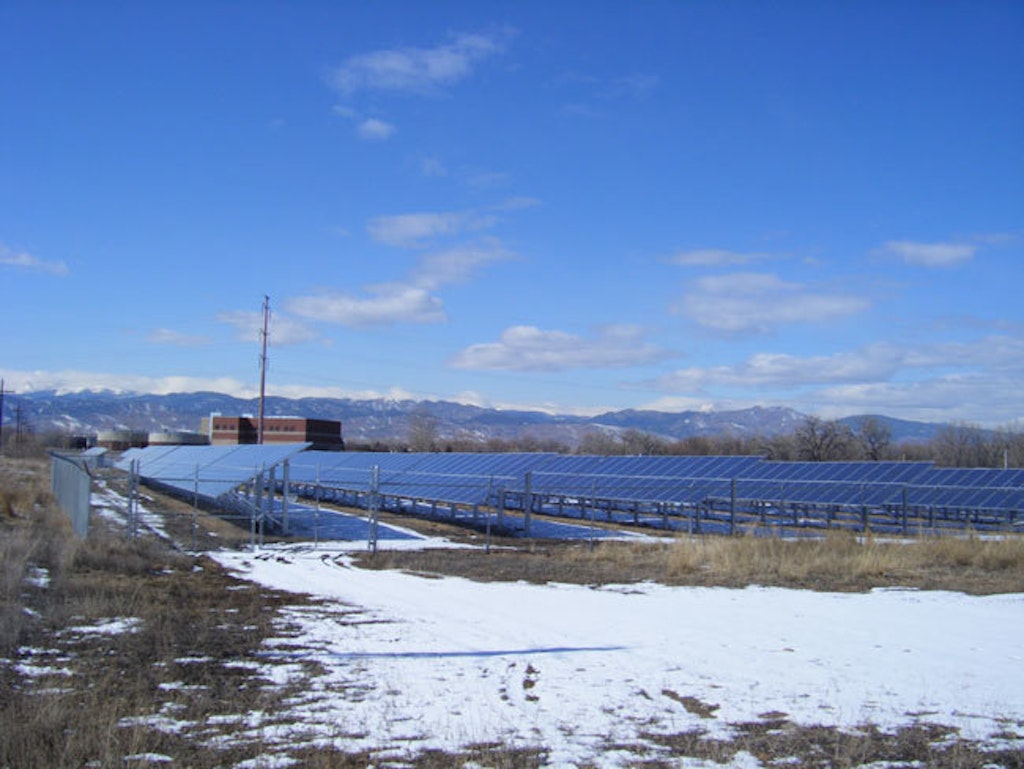
Staff members at the Boulder (Colo.) Wastewater Treatment Plant know exactly how much they will pay for about 15 percent of the facility’s electricity 20 years from now. That’s because of a 1 MW solar photovoltaic (PV) system that began supplying power to the plant last July.

The city’s Environmental Action Division developed the idea a few years ago when solar developer EyeOn Energy Ltd. approached officials about leasing five acres of city property at the treatment plant in exchange for a purchased power agreement (PPA) at rates lower than those from the local utility, Xcel Energy.

The resulting contract locks in electrical rates for 20 years at levels below what the plant now pays for the utility power it still uses, according to project manager Douglas Sullivan. “This was a great deal for the city,” he says. “We pay an average of about 6.5 cents per kWh for utility power now, and the solar facility production is about half the cost.”

The price from the PV system started at 3.25 cents per kWh and escalates at 2.75 percent per year for the first ten years, after which it will be 4.17 cents. That’s where the price will stay for the last 10 years of the contract.

“We had very few up-front costs,” adds Andrew Barth, public works communications specialist. “Normally the city would be funding large capital projects, but the brunt of this was funded by the developer and construction contractor.” Xcel was also able to count the facility toward its Portfolio Standards requirement to have 10 percent of its generation from renewables by 2020.

The system will reduce annual emission by about 3.2 million pounds of carbon dioxide, 18,000 pounds of sulfur dioxide, and 8,500 pounds of nitrous oxide. According to the U.S. EPA, that is equivalent to taking 296 cars off the road and planting 360 trees.

Exceeding expectations

As is often the case, Boulder’s treatment plant is the largest power user of all of the city’s facilities. Its on-site PV system is one of the largest in the state and one of the largest municipal systems in the country. It is designed to provide 15 percent of the plant’s annual electrical needs and would save about $43,000, according to original design estimates.

“When the facility went online, it immediately dropped one of the two utility feeds to zero, so it was providing 65 percent of the plant’s power for six hours,” says Sullivan. That happened to be a sunny day and the array went online during the peak time for sunshine (10 a.m. to 4 p.m.).

The system includes 4,452 solar panels on 900 aluminum posts in a fixed array facing due south at a 43-degree angle to the ground. The developers, who had the final decision on the design, considered a tracking system.

“They looked at a couple of different options,” says Sullivan. “There are pros and cons from a price perspective, and there is a maintenance cost associated with a tracking system. The feeling was that the fixed system made the most sense.”

The fixed system had the best cost/benefit ratio because of Boulder’s location relative to the equator and because of the climate in the Colorado mountains. “We average 300-plus sunny days a year in Boulder, so it is a beneficial spot for solar,” says Barth. Other locations may be better served by a single-axis tracking system that follows the sun, or dual-axis tracking that also adjusts to the angle of the sun in the sky.

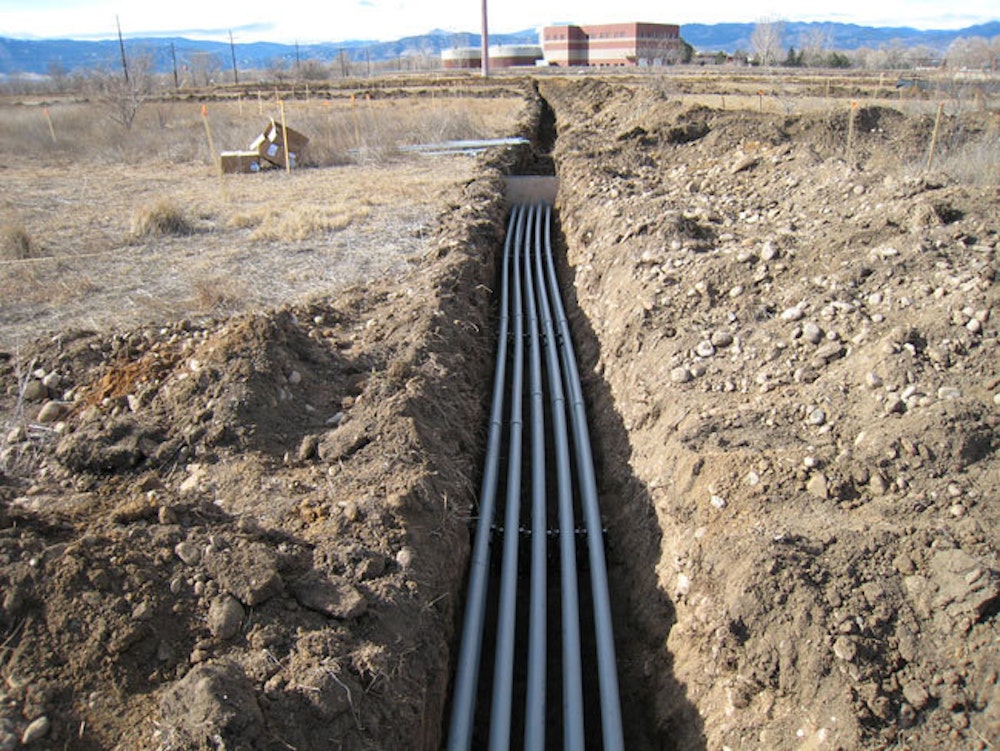
The PV system feeds power into a high-voltage switchyard in the plant. The only time plant operators may become involved is if the PV system does not automatically disconnect in case of a utility power outage. They would need to disconnect the system to prevent backfeeding of voltage onto the grid and endangering utility crews, and to prevent phasing problems with the plant’s two cogeneration engines and its emergency diesel generators.

Page 1 of 2 pages 1 2 >