As the regional grease trap waste acceptance facility for its growing population, Derry Township Municipal Authority (DTMA) was looking for a way to deal more effectively with the growing volume of material.

The answer was an aerobic grease pretreatment (AGP) unit. While the system was not a “magic bullet,” DTMA made the venture successful by careful structuring a program to accept and treat the waste. Regulation and rate modifica-tions, post-construction performance, equipment monitoring and research studies all contributed to a highly productive process for dealing with grease, improving wastewater treatment plant performance and generating revenue.

The Clearwater Road Wastewater Treatment Plant is a 5 mgd (design) advanced secondary facility that serves the unincorporated Village of Hershey, Pa., and surrounding Derry Township. The plant treats an average of 3.9 mgd, including 0.7 mgd of pretreated waste from the industrial pretreatment facility at the Hershey Co., producer of the chocolate for which the community is known.

Since 1991, DTMA has operated a highly successful septage receiving facility. From the beginning, septage was passed through a self-cleaning rotary screen and lime-stabilized to enhance settling. This removed the entire solids and organic loadings from the plant’s oversized primary clarifiers, reducing the load on the plant’s activated sludge process.

Becoming critical

“Grease has been a problem since day one,” says Wayne Schutz, assistant manager for DTMA. “However, in the late 1990s, our Collection Department began to implement a grease trap inspection program. We quickly found that until food preparation establishments could find a disposal location for the grease trap pump-outs, they couldn’t provide our inspectors with proof of trap maintenance.”

At first, DTMA accepted grease waste only from establishments in Derry Township, but the authority soon started on the path to becoming the regional grease acceptance facility. The authority established grease trap regulations early on to encourage dilution of grease trap waste on the hauling trucks as a way to avoid plugging problems.

Handling of the material was the biggest challenge. Primary clarifier scum baffles, beaches, troughs and pits required daily cleaning to control buildup. About every quarter, it was necessary to empty a primary clarifier and remove 30 to 40 cubic yards of congealed grease from the center well. A crew would enter the tank, mix the gelatinous liquid with sawdust, and remove it with a Vactor combination truck for landfill disposal. In addition, the primary sludge line had to be opened and flushed every six weeks to remove grease blockages.

Although the rates for accepting grease trap wastes reflected the main-tenance and disposal costs, the volume of grease still grew. DTMA tried numerous degreaser, enzyme and bacteria products before settling on BioGenerators from ECO Bionics, a division of NCH Corp. The product ferments bacteria in a controlled environment, allowing the population to reach exponential growth before discharge to the waste stream. The authority tested the product in a primary clarifier scum pit and found it promising, although not a solution in itself.

The design concept

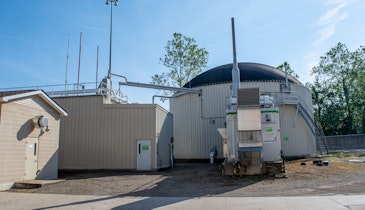
After opening a new septage receiving facility in 2002, DTMA recognized that grease would continue to be a challenge. At about the same time, preliminary design had begun for a treatment plant upgrade and expansion, and design meetings focused on ways to address the grease problem.

“We evaluated numerous acceptance and treatment alternatives and dismissed them for a variety of reasons, ranging from traffic issues to administration and operational problems,” Schutz recalls. The discussions reinforced the staff’s opinion that feeding untreated grease trap wastes directly to the anaerobic sludge digester was not acceptable.

“The grease trap waste pretreatment alternative we chose was truly a collaborative effort between DTMA staff and our engineering firm, Buchart Horn,” Schutz says. The solution, a pretreatment unit to be located at the existing septage receiving station, included these design features:

• Tank volume of 40,000 gallons (two to three times the average daily grease volume)

• Simplicity of operation

• Continued use of purchased bacteria

• Aerobic process

• Submersible chopper pumps with separate mixing and aeration cycles

• Mixing via submerged nozzles

• Aeration via simple Venturi tube technology

• Fill-and-draw batch process with mixed liquor bleed off

• pH control using available hydrated lime slurry.

Daily operation

March 2005 marked the completion and launch of the grease trap waste pretreatment facility and the AGP process. Now, instead of diluted grease waste, it was desirable to discharge the thick, full-strength loads to the treatment tank. DTMA therefore restructured its rates to create an incentive for the haulers to bring in pure grease waste. Mixed or diluted loads are now charged a higher rate.

“We are an integral part of the hauler’s business plan and they are typically receptive to our changes, whether it’s a rate increase or procedure modifications, because the same rules and standards apply to everyone,” Schutz says.

Soon after process startup, the plant staff saw some significant improvements in the treatment plant, and some minor issues with the AGP. “The improvements were almost immediate and were dramatic,” says Schutz.

“The amount of grease collecting in and on the primary clarifier influent wells, the scum baffles, beaches and V-notch weirs steadily decreased, and within a few weeks they disappeared totally. Similarly, the volume and consistency of material in the primary scum pits returned to what might be categorized as normal.”

DTMA staff performed a follow-up line cleaning of the primary sludge line to remove any residual grease and monitored discharge pressure onthe primary sludge pumps. Cleaning of the primary sludge line has not been necessary since the pretreatment system went on line.

Close to perfect

The AGP was not a perfect solution — some issues remained. In particular the amount of miscellaneous debris discharged into the tank is much higher than expected. Items like stainless steel flatware have jammed the chopper pumps numerous times. In addition, the grease waste includes more grit than expected, and the volume of lime slurry required for pH control is higher than DTMA has calculated.

The most challenging problems are odor and foam. The odor was relatively easy to manage through the proper maintenance of pH and dissolved oxygen. However, that process in turn produces foam. Although a large tank freeboard has prevented foam-outs, the process must operate at less than its optimum to keep foaming under control. To meet these challenges, the authority made improvements that included:

• Purchase of a third chopper pump

• Installation of a grinder on the truck connection to deal with the debris, grit and flatware

• Installation of a bulk magnesium hydroxide storage tank and chemical feed system as an alternative to lime for pH control

• Continued evaluation and test methods to control the foam.

“After nearly three years and treatment of more than 15 million gallons of grease trap wastewater, we consider the AGP a resounding success that has provided DTMA with an innovative way to handle large volumes of a problematic material,” Schutz says.

The process is providing other benefits, as well. The AGP process biologically transforms grease trap wastes into a mixed liquor that is periodically removed and discharged to the wastewater treatment plant headworks. In the headworks, this material mixes with plant influent and is screened and degritted. The AGP mixed liquor settles as sludge in the primary clarifiers and is pumped to the anaerobic sludge digestion process.

Huge savings

As a screened and degritted feed material with a very high fraction of volatile and highly digestible components, it provides the treatment plant’s anaerobic digester with a food source that increases methane production. The alkalinity from the pH control in the AGP process benefits the anaerobic digester as well. Finally, the AGP mixed liquor gives the treatment plant influent a steady inoculation of bacteria that attack other FOG sources in the treatment stream.

“We’ve now resolved a problem which, if left unchecked, could have resulted in sewer line plugging from grease, and pump station failures,” Schutz says. “The unit has helped us save huge amounts of time involved in cleaning tanks and lines.

“The unforeseen side effects, such as increased methane production, will contribute to additional cost savings and potential revenues in the future. The AGP process was a smart move. It was not without its challenges, but all-in-all it was a great decision for our organization.”